
Entrepreneur Legal US · Insight
Website Terms vs Mobile App Terms: What Is the Difference for a US Startup?
By Gabriel C. Mbanefo — Attorney admitted to the New York State Bar; President, Law Offices of Gabriel C. Mbanefo, P.C. d/b/a Entrepreneur Legal.
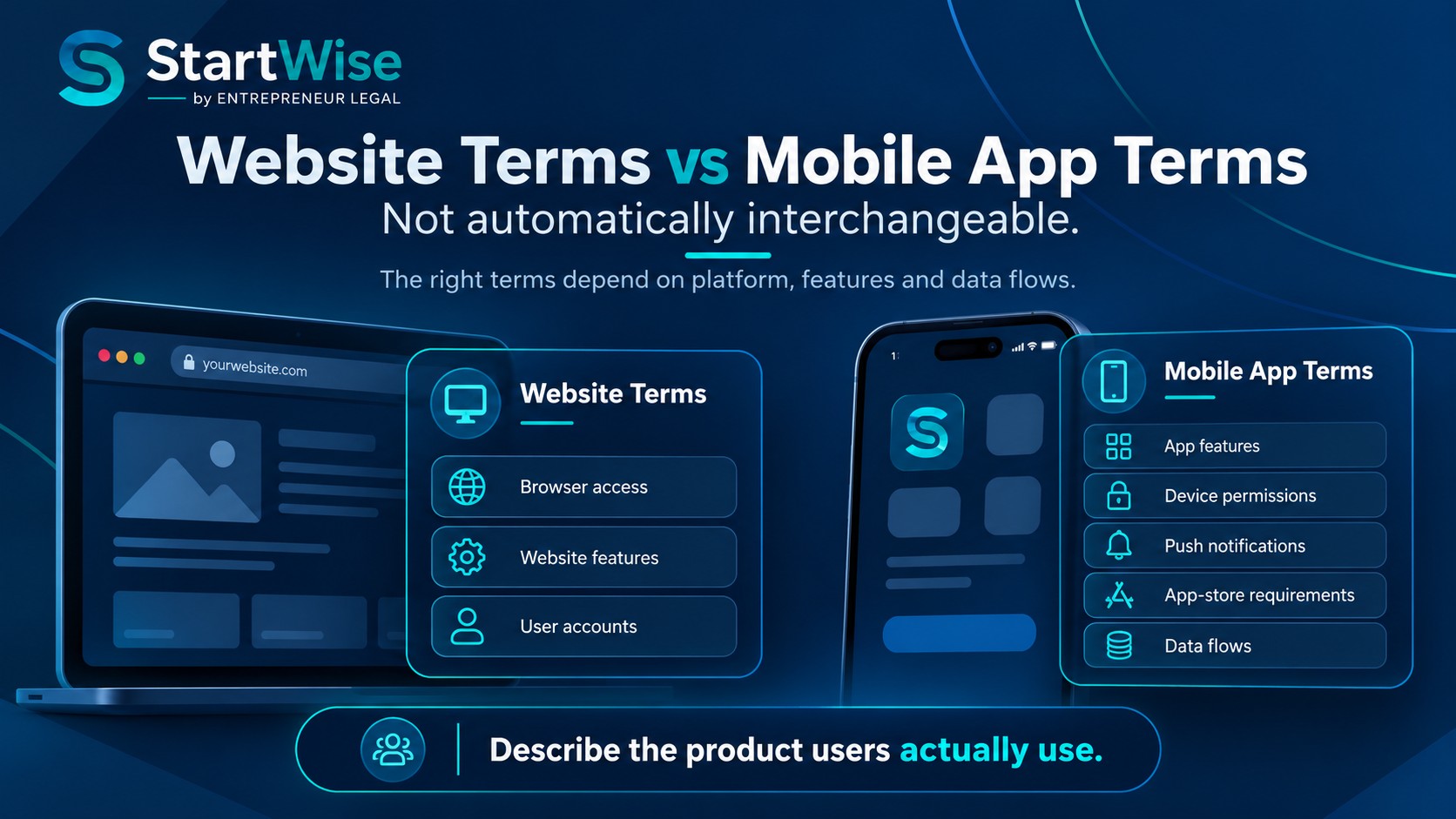
Website Terms vs Mobile App Terms at a glance
| Business question | Website Terms | Mobile App Terms |
|---|---|---|
| Where is the service used? | Browser / website experience. | Native or hybrid app, often distributed through an app store. |
| What should the terms govern? | Account, website access, checkout, user content, intellectual property, suspension, liability and disputes. | App licence, accounts, device functions, permissions, updates, stores, purchases, content, cancellation and disputes. |
| Privacy overlap? | Privacy notice should match web tracking and user data flows. | Privacy notice should match app permissions, SDKs, identifiers and mobile analytics. |
| Subscription issues? | ROSCA and relevant state renewal rules apply to the actual web checkout and billing flow. | App-store-managed billing and cancellation can add separate platform conditions; law still depends on operator and flow. |
| Can one document cover both? | Sometimes, if the product and acceptance flow are genuinely unified. | Sometimes, but only if mobile-specific rights and operational differences are actually addressed. |
| Which legal route fits? | StartWise® Website Terms of Use for guided drafting; attorney review where the sales/state context requires it. | StartWise® Mobile App Terms of Use for guided drafting; matching static Etsy template near end for simpler self-edit needs. |
The founder problem: one product, three different legal surfaces
A founder launches a SaaS platform on the web, then releases an iOS and Android app six months later. The team copies the website Terms into the app and assumes the job is finished. But the app now uses push notifications, device permissions, third-party SDKs, in-app subscriptions and app-store billing. The underlying business may be the same, but the user journey, data flows and platform rules are not.
1. Start with the actual user journey
Terms are most useful when they accurately describe how a user enters, uses and exits the service. For a website, that can mean browsing, account creation, online checkout, user uploads, subscription management and web-based functionality. For an app, the same issues can exist alongside device-level features, app-store distribution, mobile permissions, mobile identifiers and in-app purchasing.
The first drafting question is therefore not “website or app?” It is: what relationship is the business creating with the user, and where does the user encounter the terms before becoming bound?
2. Contract formation and assent still matter
A Terms link in a footer or app settings does not, by itself, establish assent. In Berman v. Freedom Financial Network (9th Cir. 2022), the court emphasised reasonably conspicuous notice and an unambiguous manifestation of assent. Whether terms are incorporated and enforceable depends on the actual design, presentation and applicable contract law. Make sign-up, account creation and checkout show the relevant terms at an appropriate stage.
A founder should test the web and in-app acceptance screens, record consent/version history where appropriate, and check whether material limitations, renewal terms or arbitration provisions are displayed with sufficient notice rather than relying on a document alone.
3. Mobile apps add platform and device-specific issues
Mobile App Terms may address distribution, app licence scope, platform responsibilities, app updates and removal, device compatibility, user-generated content, third-party services, permissions, notifications and in-app purchases. Apple supplies a standard end-user licence agreement (EULA) unless a developer provides a custom EULA; this is a different question from whether separate service terms are useful for accounts, subscriptions or content. A custom Apple EULA must meet Apple’s minimum terms. Google Play has its own developer policies, including privacy and data-disclosure duties.
4. Privacy documentation should follow the real data map
Websites may use cookies, pixels and analytics; apps may use advertising identifiers, SDKs, crash analytics, location, contacts or camera permissions. The legal notices and technical controls should reflect what each surface actually collects, uses and shares. Apple requires app privacy-policy disclosures and app privacy information; Google Play requires a privacy policy and accurate Data safety disclosures, including relevant SDK data practices. Platform disclosures do not replace applicable federal or state privacy duties.
For businesses within its scope, California’s CCPA can impose notice, rights and opt-out requirements. Updated CPPA regulations took effect on 1 January 2026; certain obligations have staggered deadlines. For example, covered risk assessments began in 2026, while requirements concerning specified automated decisionmaking uses begin on 1 January 2027. Other states have distinct thresholds and requirements: a California-focused notice is not automatically sufficient nationwide.
5. Subscription and renewal rules can differ by channel and state
For online negative-option subscriptions, the federal Restore Online Shoppers’ Confidence Act (ROSCA) remains relevant to material disclosures, express informed consent and simple mechanisms to stop recurring charges. The FTC’s broader 2024 “Click-to-Cancel” rule was vacated by the Eighth Circuit on 8 July 2025; do not present it as binding law. California and New York separately regulate automatic renewals, and in-app purchases can be subject to app-store billing and cancellation arrangements. The actual seller, billing entity, channel and customer location matter.
In California, amended Business and Professions Code §17602 applies to qualifying agreements entered into, amended or extended on or after 1 July 2025, with detailed requirements for affirmative consent, acknowledgement, online cancellation, notices and retention of evidence. New York General Business Law §§527–527-a has its own requirements, including clear material terms, affirmative consent, an acknowledgement and cancellation arrangements. These are state-specific illustrations, not a single national checklist. Map the checkout, renewals, billing and cancellation flow before drafting the Terms.
6. Children’s apps may require COPPA compliance beyond Terms
The Children’s Online Privacy Protection Act and FTC Rule can apply to child-directed online services collecting personal information from children under 13, and to some general-audience services with actual knowledge of that collection. The amended COPPA Rule generally required compliance by 22 April 2026, subject to specified exceptions. Covered operators may need verifiable parental consent, privacy notices, data-handling controls and vendor/SDK oversight. Terms and an age-gate alone do not satisfy those obligations.
7. One combined set of Terms can work, but only if the product is truly unified
One Terms of Service document may cover web and mobile where the same operator, account, services and contract structure genuinely apply, and where app-specific licensing, permissions, purchase and support provisions are included. Otherwise, an app-specific annex or separate agreement may be clearer. Test both acceptance interfaces and keep the privacy policy, app-store disclosures and billing controls consistent with the selected structure.
Common mistakes and practical consequences
| Mistake | Practical consequence |
|---|---|
| Copying Website Terms into the app without review | Mobile permissions, app-store distribution, in-app purchases or app-specific features can be left unaddressed. |
| Treating privacy as identical across web and app | SDKs, identifiers and permissions can create different data flows from the website. |
| Hiding Terms after sign-up | The business may create an assent/enforceability problem under applicable contract law. |
| Using one nationwide renewal clause | State automatic-renewal rules may require different disclosures or operational steps. |
| Assuming app-store rules replace your own Terms | Platform rules and the startup-user contract are separate layers. |
| Treating the vacated FTC Click-to-Cancel Rule as current law | The business may misstate the federal position while missing ROSCA and applicable state requirements. |
| Treating Apple’s standard EULA as the entire service agreement | Accounts, user content, refunds or other contractual issues may not be appropriately addressed. |
| Using an age-gate as the only children’s privacy control | Covered services may lack COPPA notices, parental consent or vendor/data safeguards. |
How StartWise® Drafting fits
For a reasonably standard website or mobile app where the user relationship and relevant legal requirements are understood, StartWise® Drafting offers both Website Terms of Use and Mobile App Terms of Use (platform-owner availability confirmed 16 October 2026 following recent additions).
Choose the relevant document, answer guided questions, generate a tailored first draft and review Drafting Notes. Those notes can identify assumptions and implementation points, but are not legal advice and cannot decide state-law applicability or assure compliance.
Use attorney support where the service is regulated, involves children or sensitive data, has significant multistate renewal exposure, uses complex billing, or faces disputed enforceability/consumer-rights issues. For someone who already understands a straightforward app-specific static-document need, Entrepreneur Legal US separately offers an editable Mobile App Terms of Use template on Etsy. A static template is not the same as guided drafting or attorney review and does not implement app-store or statutory controls.
Frequently asked questions
Can I use the same Terms for my website and mobile app?
Sometimes. A combined document can work if the same account/service relationship applies and the document addresses mobile-specific issues. Do not assume one form is sufficient merely because the brand is the same.
Do app-store terms replace my own Mobile App Terms?
Not always. Apple applies its standard EULA if a developer does not provide a custom EULA; a custom EULA must meet Apple’s requirements. A business may still need its own service Terms for subscriptions, accounts, content and support, and Google Play has separate developer policies. Analyse the app licence and service relationship separately.
Do I need a separate Privacy Policy for the app?
Not necessarily as a separate document, but the privacy notice must accurately cover the app’s data collection, SDKs, permissions and state-law obligations.
Are automatic-renewal rules the same in every state?
No. ROSCA applies to covered online negative-option offers; the FTC’s 2024 Click-to-Cancel Rule was vacated in July 2025. California and New York have separate renewal statutes, and app-store billing can change the practical cancellation path.
Can StartWise® tell me which state privacy law applies?
No. StartWise® is guided drafting. Applicability, exemptions and higher-risk multistate analysis may require attorney review.
Does the FTC Click-to-Cancel Rule currently apply?
The 2024 FTC rule was vacated in July 2025. ROSCA and applicable state automatic-renewal laws remain relevant; check current law before launch.
What if the app is directed to children under 13?
COPPA may apply, including notice, parental-consent and data-handling obligations. The amended FTC COPPA Rule generally had an April 2026 compliance date. This requires operational review, not just Terms.
Author, legal-review and update information
Author / reviewer: Author: Gabriel C. Mbanefo, Attorney admitted to the New York State Bar; President, Law Offices of Gabriel C. Mbanefo, P.C. d/b/a Entrepreneur Legal. Biography: https://us.entrep.legal/about/. Final attorney review/approval to be confirmed before publication.
Planned publication date: 22 October 2026.
Current source-check date: 16 October 2026 — editorial verification of the cited federal/state rules and app-store documentation. Final attorney sign-off and 22 October source/product check pending.
Jurisdiction statement: General United States information. Federal ROSCA and COPPA provisions may apply where triggered; California and New York examples are state-specific and should not be extrapolated to every state. Not legal advice.
Sources and related Entrepreneur Legal resources
- ROSCA, 15 U.S.C. §8403 — online negative-option marketing.
- Custom Communications, Inc. v FTC, No. 24-3137 (8th Cir., 8 July 2025) — vacating the 2024 FTC negative-option rule.
- California Business and Professions Code §17602 — automatic renewals.
- New York General Business Law §527-a — automatic renewals.
- California Privacy Protection Agency, 2026 amended regulations and implementation dates.
- COPPA Rule amendments, 90 Fed. Reg. 23,128 (22 April 2025) — general compliance date 22 April 2026.
- Berman v Freedom Financial Network, 30 F.4th 849 (9th Cir. 2022) — online notice/assent.
- Apple: Standard EULA vs developer-supplied custom EULA.
- Apple App Review Guidelines — privacy-policy and data disclosures.
- Google Play developer data and privacy policies.
- Entrepreneur Legal US: Website Legal Requirements in the US.
Choose the right next step
Compare the web and app journeys before drafting.
For a reasonably standard product where the user relationship and legal position are understood, explore the current guided US documents through StartWise. Use attorney support for regulated services, children, sensitive data, multistate subscriptions, unusual monetization or material disputes.


