
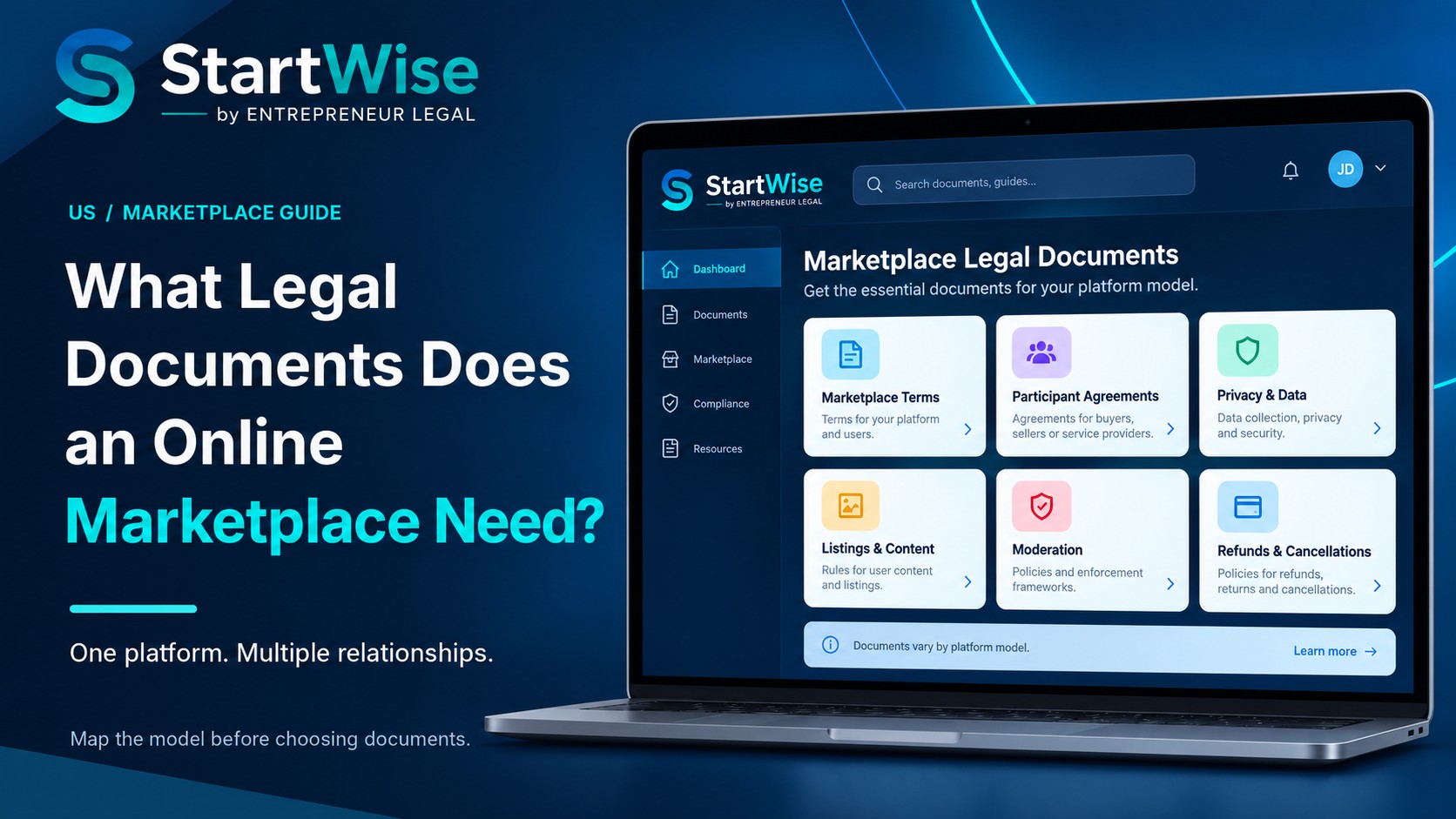
Entrepreneur Legal US · Insight
What Legal Documents Does an Online Marketplace Need in the US?
By Gabriel C. Mbanefo, Esq. — Attorney admitted to the New York State Bar and Solicitor of the Senior Courts of England and Wales; President, Law Offices of Gabriel C. Mbanefo, P.C. d/b/a Entrepreneur Legal.
Marketplace document stack at a glance
| Business question | Likely document / control | Why it matters |
|---|---|---|
| Who contracts with the buyer? | Marketplace Terms + seller/customer transaction terms | Operator role affects consumer claims, refunds and liability. |
| Who may sell? | Seller Terms / Vendor Agreement + verification process | Onboarding, fees, prohibited activity and INFORM Act duties may apply. |
| Can users post listings/reviews/content? | Content Policy + Acceptable Use + moderation/takedown process | Contract rules support enforcement but do not replace federal/statutory duties. |
| How is personal information used? | Marketplace Privacy Policy + state rights process | Data flows often involve buyers, sellers and vendors across states. |
| Does the platform receive funds? | Payment architecture + payout terms | Money transmission/payment regulation is model-specific and can require separate analysis. |
| How are IP complaints handled? | DMCA agent/takedown process + terms | Section 512 safe-harbor requirements are operational, not just contractual. |
| Who collects sales tax on transactions? | Seller Terms + tax collection and remittance procedures | Marketplace-facilitator laws may place collection duties directly on qualifying operators. |
| Who reports seller payments? | Payment-service agreements + 1099-K reporting data | The responsible payment settlement entity and applicable reporting thresholds must be identified. |
The founder problem: “we only connect buyers and sellers” may not describe the real business
A founder describes the product as a simple marketplace. In practice, the company verifies sellers, collects payments, ranks listings, publishes reviews, handles refunds, suspends accounts, stores buyer and seller data and decides which disputes are escalated. Those functions can trigger different legal frameworks. The document stack should follow what the platform actually does, not the label used in the pitch deck.
1. Map the contracting model first
Identify whether the operator is the seller, an agent, an intermediary, a reseller or another kind of participant for each part of the transaction. If the buyer contracts with the third-party seller, the marketplace terms should accurately explain the operator’s role and the seller terms should allocate fulfillment, listing accuracy, taxes, refunds and compliance. If the operator is actually supplying the goods or services, the legal structure changes.
2. Covered marketplaces have federal seller-verification duties under the INFORM Consumers Act
The INFORM Consumers Act, codified at 15 U.S.C. § 45f, requires covered online marketplaces to collect, verify and in some cases disclose specified information about certain high-volume third-party sellers. FTC guidance also addresses annual certification/currentness, seller disclosures and a mechanism for consumers to report suspicious activity.
That means seller onboarding is not only a Terms issue. The product needs fields, verification logic, recordkeeping and disclosure controls that reflect the statute where it applies.
3. Reviews are regulated conduct, not decorative content
The FTC Consumer Reviews and Testimonials Rule, effective in 2024, prohibits defined fake or false review activity, sentiment-conditioned incentives, certain insider reviews, deceptive suppression and other specified conduct. However, the rule contains a limited exception when a platform does no more than host consumer reviews, even when it solicits submissions or aggregates star ratings. Mere hosting does not, under that rule alone, require screening every review. The exception does not immunize the platform’s own fake-review purchases, advertising use, manipulation or other deceptive conduct.
Seller terms can prohibit review manipulation, and the operator should have a proportionate process to address suspected abuse, reports and legally required removals. Classify whether the business is merely hosting reviews or creating, purchasing, promoting or using testimonials in advertising before describing the rule as imposing a screening duty.
4. User content creates DMCA and platform-liability questions
If sellers or users upload photos, descriptions, videos or other material, copyright complaints are foreseeable. Section 512 of the Copyright Act offers different safe harbors to qualifying service providers, subject to statutory requirements, including a repeat-infringer policy and, for applicable hosted-content protections, a Copyright Office-registered designated agent and an operational notice-and-takedown/counter-notice process. An online agent designation must be renewed at least every three years (or updated earlier when information changes); a clause in Marketplace Terms alone is insufficient.
47 U.S.C. § 230 can also affect liability for third-party content, but its scope is not universal and it does not replace intellectual-property, federal criminal or other excluded legal regimes. Do not write “we are not responsible for user content” as if one disclaimer answers every category of risk.
5. Payment flow should be designed before payout terms are drafted
A marketplace that receives customer funds and transmits them to sellers may raise federal or state money-transmission questions. Classification depends on the actual fund flow, the entity controlling money, contracts with the seller, and any applicable payment-processing exclusion or licensed-provider arrangement. FinCEN identifies fact-specific exemptions for qualifying payment processing, but these do not automatically resolve state licensing requirements. Design the payment architecture with appropriate specialist support before drafting payout, reserve and chargeback terms.
6. Marketplace-facilitator sales tax can fall directly on the platform
State marketplace-facilitator rules may make a qualifying platform responsible for collecting and remitting sales or use tax on third-party sales. New York requires qualifying marketplace providers to collect tax on covered facilitated sales; California generally treats qualifying facilitators as retailers for certain marketplace transactions. Coverage, nexus, taxable products, exemptions and documentation differ by state. Seller Terms should address cooperation and evidence, but a contract cannot simply transfer a statutory collection obligation away from the responsible operator.
7. Form 1099-K seller-payment reporting is a different tax regime
Federal Form 1099-K reporting is separate from sales-tax collection and INFORM Act seller verification. Under current IRS guidance, a third-party settlement organization (TPSO) generally must report gross payments to a participating payee when payments exceed $20,000 AND the number of transactions exceeds 200 in a calendar year; the federal payment-card reporting regime has different rules, and states may apply lower reporting thresholds. The entity actually required to report depends on the payment settlement structure, not simply on whether the platform calls itself a marketplace. Obtain appropriate tax advice for provider roles, TIN collection, recordkeeping and reporting, and remember that income may be taxable even without a Form 1099-K.
8. State privacy and consumer law can add another layer
Marketplaces process buyer and seller information, identity documents, payment-related data and behavioral data. Depending on applicability thresholds, state privacy laws can impose notices, access/deletion rights, opt-outs, contracts and governance requirements. California is a concrete example: revised CCPA regulations took effect on 1 January 2026; certain risk-assessment obligations and later-stage automated-decisionmaking compliance dates require attention where applicable.
California does not establish one national rule. Map each state, role, vendor and sensitive-data use before finalizing a privacy policy or rights-handling process.
9. Product categories, recalls and unsafe goods
A marketplace for ordinary handmade goods is not the same as a marketplace for financial services, healthcare, alcohol, firearms, transportation or other regulated offerings. Product categories and the platform’s actual participation may create direct legal obligations even where seller terms allocate responsibilities. The CPSC warns that selling recalled or banned consumer products is unlawful and actively monitors online listings. Platforms dealing with physical products should design appropriate listing restrictions, recall checks, reports, delisting and recordkeeping controls, proportionate to the marketplace’s role and applicable law; duties are not identical for every platform.
10. Build enforcement rights around real operational decisions
Good marketplace documents explain when listings can be removed, sellers suspended, payouts held where lawful, content moderated, information requested and accounts terminated. The product team then needs evidence, notice, escalation, appeal and recordkeeping procedures to implement those provisions fairly and preserve statutory rights. Operational check: map the operator’s role; verify INFORM coverage; classify reviews; design DMCA controls; assess payment and Form 1099-K reporting roles; identify sales-tax collection states; audit privacy rights; and plan safety recalls before launch.
Common marketplace mistakes and consequences
| Mistake | Practical consequence |
|---|---|
| Using one generic Terms page for buyers and sellers | Rights, fees, refunds and compliance responsibilities can become unclear. |
| No INFORM Act onboarding design | Covered marketplace may lack required verification/disclosure controls. |
| Paying users to leave positive reviews | FTC review-rule risk. |
| No DMCA process or designated agent where needed | Potential loss of safe-harbor protection for qualifying hosted content. |
| Using a payment clause to solve a payment-regulation question | The regulatory perimeter is not created or removed by contract wording. |
| Assuming Section 230 eliminates all platform liability | Important exceptions and other legal regimes remain. |
| Assuming sellers always remit sales tax | Marketplace-facilitator laws can impose a separate statutory duty on the operator. |
| Treating 1099-K as the same as sales tax or INFORM | Distinct filer, seller-verification and collection duties may be missed. |
| Claiming every hosted review must be investigated | The FTC rule’s limited mere-hosting exception may be misdescribed. |
| Failing to renew a registered DMCA agent | An expired agent registration can undermine reliance on applicable Section 512 safe harbors. |
| Leaving recalled consumer products listed | Recall, safety and prohibited-product exposure can persist beyond contractual seller obligations. |
How StartWise® Drafting fits
StartWise® Drafting currently offers the following US marketplace/platform documents: Marketplace Terms of Use, Host / Vendor Agreement, Platform-Focused Privacy Policy, Content Policy, Acceptable Use Policy, Marketplace Seller Terms, Platform Moderation Terms and Host Declaration. A founder can choose the relevant available document, answer guided questions, generate a tailored first draft and review any Drafting Notes. Separate Privacy Policy, Website Terms of Use and Refund and Cancellation Policy documents may also be relevant depending on the operating model. Confirm current availability immediately before publication.
Drafting Notes can identify assumptions and implementation points; they are not legal advice, attorney review or an exhaustive compliance audit. They cannot decide INFORM coverage, Section 512 eligibility, sales-tax nexus, who is a Form 1099-K filer, whether payment services are regulated, or which state privacy and product rules apply. Classify those issues first. No single set of documents guarantees compliance. For a missing document, request it through StartWise; for multistate, regulated or uncertain matters, seek appropriately scoped attorney and tax support.
Frequently asked questions
Does every US marketplace need separate buyer and seller terms?
Not necessarily, but separate documents are often clearer where the operator has materially different relationships with buyers and sellers.
Does the INFORM Consumers Act apply to every seller?
No. The statute focuses on covered marketplaces and specified high-volume third-party sellers. Check the statutory definitions and current FTC guidance.
Do I need a DMCA agent?
Potentially, if the platform relies on relevant Section 512 safe harbors for hosted user content. Registration and operational takedown procedures should be reviewed together.
Does Section 230 protect a marketplace from every user-content claim?
No. Section 230 has important limits and exclusions and should not be treated as a universal immunity.
Can StartWise build the whole compliance framework?
No. StartWise assists with available documents. Regulatory analysis, technical controls, seller verification, tax/payment architecture and operational implementation sit outside guided drafting.
Does a marketplace have to collect sales tax for its sellers?
Sometimes. Marketplace-facilitator statutes can place the collection and remittance obligation on qualifying operators; thresholds and covered transactions depend on the state. Check New York, California and every other relevant state.
Does the marketplace itself issue Form 1099-K?
Not automatically. Federal reporting depends on which business is the payment settlement entity, the transaction type and applicable thresholds; a regulated payment provider may be responsible instead. State reporting rules may differ.
Must I verify every review under the FTC rule?
Not merely because you host consumer reviews. The rule has a limited exception for mere hosting, but your own fake reviews, paid sentiment-conditioned reviews, promotional testimonials and deceptive practices can still create liability.
How often must I renew my DMCA agent?
A registered online designated-agent filing generally must be renewed within three years and updated when necessary. It is only one part of meeting the applicable statutory safe-harbor conditions.
Author, legal-review and update information
Author / reviewer: By Gabriel C. Mbanefo, Esq., Attorney admitted to the New York State Bar and Solicitor of the Senior Courts of England and Wales; President, Law Offices of Gabriel C. Mbanefo, P.C. d/b/a Entrepreneur Legal. About: https://us.entrep.legal/about/ | Substantive legal review: 16 October 2026. No separate attorney reviewer is represented as having reviewed this article.
Planned publication date: 29 October 2026.
Current source-check date: 16 October 2026 for the materially revised official US sources (existing baseline originally checked 26 August 2026).
Jurisdiction statement: This is a multistate US topic. The article identifies nationwide federal frameworks where they exist and does not treat state privacy, tax, product, payment or consumer rules as uniform. The operator’s actual role, money flow, seller type, product category and user-content features determine the analysis.
Sources and related Entrepreneur Legal resources
- 15 U.S.C. §45f (INFORM Consumers Act).
- FTC INFORM Consumers Act guidance.
- FTC Consumer Reviews and Testimonials Rule Q&A.
- 17 U.S.C. §512.
- U.S. Copyright Office DMCA Designated Agent Directory.
- 47 U.S.C. §230.
- IRS Form 1099-K FAQs and current TPSO thresholds.
- New York marketplace provider sales-tax guidance.
- California CDTFA Marketplace Facilitator Act guide.
- California Privacy Protection Agency: 2026 CCPA regulations.
- FTC Consumer Reviews Rule Q&A (mere hosting).
- Copyright Office DMCA Agent Directory FAQs.
- CPSC: Buying and Selling Products Online.
- FinCEN payment-processing guidance.
- Entrepreneur Legal US StartWise Access.
- Entrepreneur Legal US: What Legal Documents Does a US Startup Need?
- Entrepreneur Legal US: Website Legal Requirements in the US.
- Entrepreneur Legal US: Commercial Agreements (US).
- Entrepreneur Legal US Insights.
Important information
StartWise® Drafting is not legal advice, attorney review, legal approval or legal sign-off. Creating an account, purchasing drafting credits or generating a document does not by itself create an attorney-client relationship. Legal services are provided only after applicable conflicts and onboarding requirements are completed and an engagement is accepted. Law Offices of Gabriel C. Mbanefo, P.C. d/b/a Entrepreneur Legal | https://us.entrep.legal/ | hello@us.entrep.legal
Choose the right next step
Map the marketplace first. Then draft the documents.
For a reasonably standard model where the operator role and regulatory perimeter are understood, explore the current guided US documents through StartWise. Use attorney or tax support for multistate, payment, tax, verification, IP, privacy, product or other regulated issues.


