Entrepreneur Legal US · Insight
What Should a US Services Agreement Include?
By Gabriel C. Mbanefo, Esq. - Attorney admitted to the New York State Bar and Solicitor of the Senior Courts of England and Wales; President, Law Offices of Gabriel C. Mbanefo, P.C. d/b/a Entrepreneur Legal.
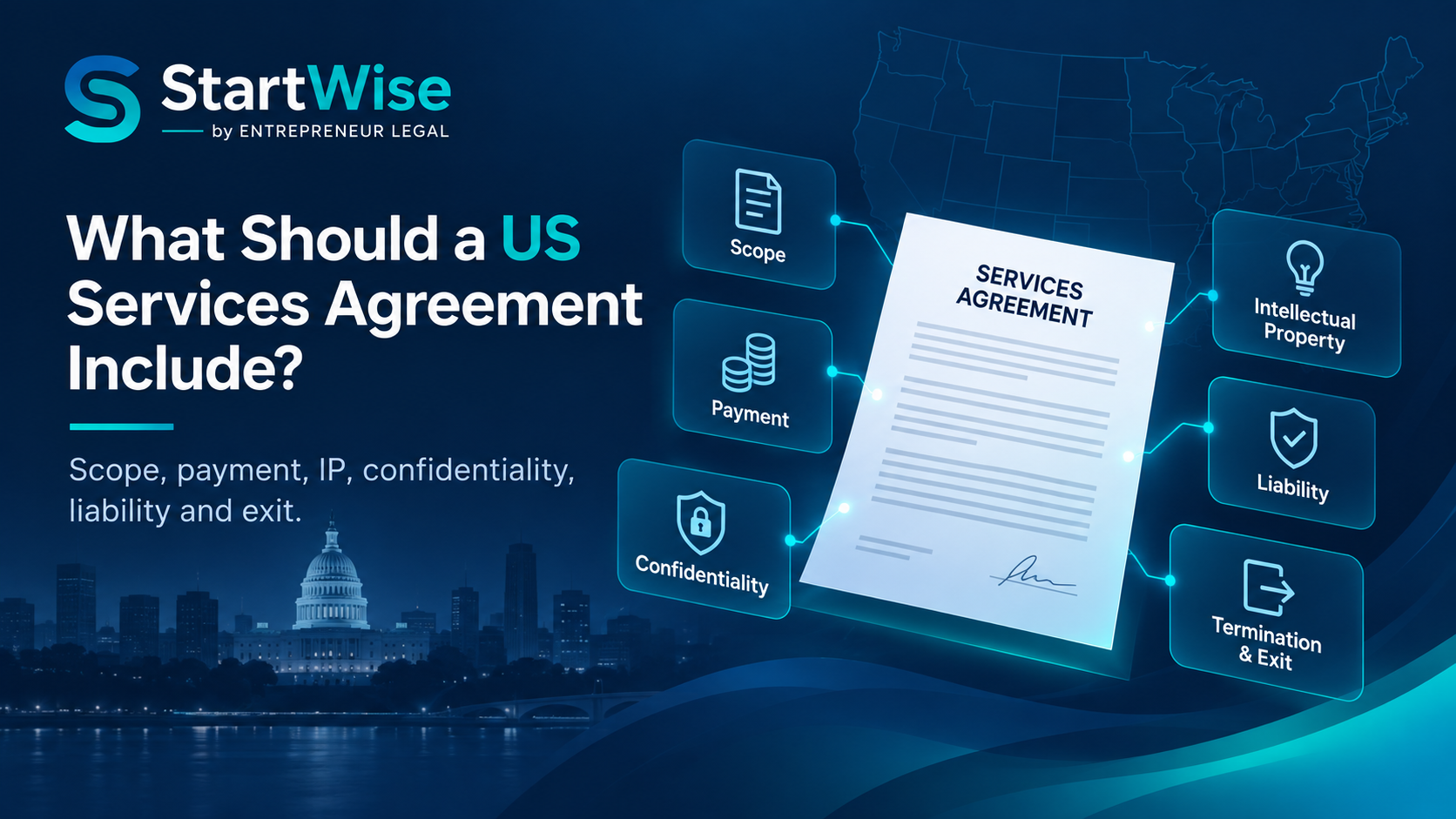
Services agreement clauses at a glance
| Clause area | What it should decide | Legal / operational watch-out |
|---|---|---|
| Parties and authority | Correct legal entities, addresses and signatory authority. | A brand name is not necessarily the contracting entity. |
| Scope and deliverables | Services, milestones, exclusions, assumptions and client dependencies. | Vague scope makes change, delay and acceptance disputes more likely. |
| Fees and expenses | Fixed/hourly fees, retainers, deposits, taxes, invoice triggers and reimbursable expenses. | Late-fee, interest and collection remedies can be state-sensitive. |
| Change control and acceptance | Who can approve changes; effect on fees/timing; testing and rejection process. | Informal “small changes” can become unpriced scope. |
| IP | Pre-existing IP, project-created work, assignments, licenses and third-party materials. | Payment alone does not automatically transfer contractor copyright. |
| Confidentiality and data | Protected information, permitted use, security, return/deletion, data schedules. | Trade-secret notice and privacy/security rules may require more than an NDA clause. |
| Warranties | Performance standard, authority, non-infringement and other specific promises. | Avoid promising results outside the provider’s control. |
| Liability, indemnity and insurance | Caps, exclusions, third-party claims and required coverage. | State law and subject matter can affect enforceability. |
| Term and termination | Start/end, breach, cure, convenience termination and exit obligations. | Address fees, work-in-progress, data, access and surviving clauses. |
| Governing law and disputes | State law, venue, courts or arbitration where appropriate. | Choice-of-law/forum rules are not identical nationwide. |
Founder scenario: the proposal was enough to sell the project, not enough to run it
A Delaware SaaS company hires a New York software development company for a $150,000 analytics build. The proposal identifies features, price and a target launch date. It does not say how the client must supply API access, how many acceptance cycles are included, whether reusable libraries remain the studio’s property, what happens if the client changes the specification, who bears third-party license costs, what security obligations apply, or what happens to work in progress if the relationship ends.
That is a clean services-agreement problem because the parties are businesses and the difficult questions are commercial allocation rather than worker status. The agreement should turn the sales understanding into rules both sides can follow when the project changes.
1. Identify the actual contracting parties and document hierarchy
Use the correct legal names and make clear which documents form the deal. If the parties use a master services agreement, statement of work, proposal, order form or security schedule, state how they interact and which document controls if provisions conflict. This is especially important where commercial teams continue updating proposals after legal terms have been negotiated.
2. Make the scope operational
The scope should define deliverables, milestones, dependencies, exclusions and assumptions at a level the project team can use. If the client must provide data, approvals or system access, connect those obligations to the supplier’s timetable. A deadline that ignores client dependencies can create a dispute even where both sides acted reasonably.
3. Payment terms need triggers, not just a number
State when invoices may be issued, when they are due, how retainers or deposits are treated, whether expenses require approval, how taxes are handled and what happens to genuinely disputed amounts. Avoid a generic nationwide late-fee statement: interest, fee-shifting and collection remedies can depend on governing law and the transaction.
4. Change control and acceptance prevent informal scope from becoming permanent
The contract should identify who may authorize additional work, how price and schedule changes are documented, and whether work continues while a change request is unresolved. Acceptance provisions can distinguish a real defect from a preference change, set review periods and explain what happens after rejection or deemed acceptance.
5. IP ownership must be explicit
US copyright law starts from authorship, not payment. Under 17 U.S.C. § 101, specially commissioned work qualifies as work made for hire only in specified categories and where the parties expressly agree in a signed writing. A transfer of copyright ownership otherwise generally requires a signed writing under 17 U.S.C. § 204.
A services agreement should therefore separate the provider’s pre-existing code, tools, templates, libraries and know-how from project-created deliverables. It should then state what is assigned, what is licensed, whether the provider may reuse general know-how, and how third-party/open-source components are handled.
6. Confidentiality clauses can have a federal trade-secret drafting point
Confidentiality provisions should identify protected information, permitted use, disclosure exceptions, security expectations, return/deletion and survival. Where an agreement with an individual contractor or consultant governs trade secrets or confidential information, 18 U.S.C. § 1833(b) also matters. The statute protects specified whistleblower disclosures and requires notice of that immunity if the employer wants access to certain DTSA remedies; for this rule, the statutory definition of employee includes contractors and consultants.
That notice point does not turn a general confidentiality clause into a complete trade-secret program. Access controls, vendor security, state privacy law and sector requirements may require separate work.
7. Warranties should match what the provider can actually control
A services provider may reasonably promise authority to contract, professional performance standards, compliance with agreed specifications, or that it will not knowingly introduce specified materials without permission. Outcome guarantees should be approached carefully. A marketing agency can control agreed services; it cannot necessarily guarantee a revenue result.
8. Liability, indemnity and insurance are risk-allocation clauses, not boilerplate
The parties should identify the real loss scenarios: IP claims, confidentiality breaches, data/security incidents, service interruption, damage to property, third-party claims and the consequences of missed milestones. Caps, exclusions, carve-outs, indemnities and insurance should be designed around those risks. Their enforceability can vary by state and subject matter, so a material or heavily negotiated allocation should be reviewed rather than copied from another agreement.
9. Governing law, forum and arbitration require a deliberate choice
A governing-law clause does not create one national contract regime. New York provides a concrete example: General Obligations Law § 5-1401 permits parties to certain transactions of at least $250,000 to choose New York law even without a reasonable relation to New York, but the statute expressly excludes contracts for labor or personal services and other listed categories. Section 5-1402 separately permits a New York forum in certain transactions of at least $1 million only where the agreement includes a qualifying New York-law choice under § 5-1401 and the other statutory conditions are satisfied. These are New York-specific rules. The $150,000 SaaS-development scenario above is a separate illustration of a services-agreement problem and does not rely on §§ 5-1401 or 5-1402.
If the parties use arbitration in a transaction involving commerce, the Federal Arbitration Act can be relevant. Section 2 generally makes written arbitration agreements enforceable subject to ordinary contract-law grounds for revocation and statutory exceptions. The clause should still address seat/venue, rules, scope and any state-specific enforceability concerns.
10. Electronic signing is usually workable, but it does not erase substantive requirements
The federal E-SIGN Act generally prevents a contract or signature in a transaction involving interstate or foreign commerce from being denied legal effect solely because it is electronic. It does not remove the substantive requirements of another law, and special consumer-disclosure rules can apply where a statute requires information to be provided in writing. A B2B services agreement should still be executed in a way that preserves a reliable record.
11. Termination should plan the handover
Address expiration, termination for material breach, cure periods, insolvency events, any termination-for-convenience right, final invoices, payment for committed work, work-in-progress, data return/deletion, access revocation, transition support and the provisions that survive. Exit mechanics are often more valuable than a long list of abstract termination triggers.
A practical B2B services-agreement checklist
- Confirm the correct legal entities and signatories.
- Define the scope, exclusions, client inputs, milestones and acceptance process.
- Set invoice triggers, payment dates, taxes, approved expenses and dispute mechanics.
- Create a written change-control path.
- Separate pre-existing IP from project-created work and document assignments/licenses expressly.
- Address confidentiality, DTSA notice where applicable, security and data handling.
- Write warranties around controllable obligations rather than guaranteed outcomes.
- Design liability, indemnity and insurance around the real project risks.
- Choose governing law and dispute process deliberately, with state-specific review where material.
- Plan termination, handover, access revocation and surviving obligations.
Common mistakes and practical consequences
| Mistake | Practical consequence |
|---|---|
| Treating a proposal as the entire contract | Scope, acceptance, IP, data, liability and exit remain unclear. |
| Assuming payment transfers all IP | The customer may not own contractor-created copyright or reusable components as expected. |
| Copying confidentiality language | DTSA notice, security or privacy requirements may be missed. |
| Using a generic liability cap | The clause may not match governing law or the project’s actual exposure. |
| Choosing governing law by habit | The parties may create avoidable forum/enforceability complexity. |
| Ignoring termination handover | Access, data, work-in-progress and final payment become disputed at the worst time. |
How StartWise™ Drafting fits
StartWise currently includes a US Services Agreement. For a routine B2B services relationship where the commercial terms and jurisdictional context are reasonably clear, guided questions can help structure the deal and generate a tailored first draft. Drafting Notes can highlight selected assumptions, points to confirm and circumstances where attorney review may be appropriate.
StartWise does not determine governing law, resolve regulated-industry requirements, design complex data/security architecture, negotiate material indemnities or decide whether a cross-border or consumer-facing transaction is appropriate for self-service drafting.
Prefer a static downloadable template?
If the business has already selected the right document, settled the key commercial terms and jurisdictional context, and is comfortable adapting a one-off form without guided questions, Entrepreneur Legal US also offers an Attorney-Drafted Client Service Agreement Template on Etsy. This is a secondary self-service option rather than a substitute for state-specific advice, regulated or consumer analysis, negotiation, or complex IP, data, security, indemnity or liability work.
Frequently asked questions
Is there one standard US services agreement?
No. A common commercial structure exists, but contract law is state-based and the service, parties, industry, data practices, governing law and negotiation can change what the agreement needs.
Does paying a contractor automatically give the customer the copyright?
No. Work-made-for-hire treatment is limited by 17 U.S.C. § 101, and a transfer of copyright ownership generally requires a signed writing under 17 U.S.C. § 204.
Can a services agreement be signed electronically?
Often yes. The federal E-SIGN Act generally prevents denial of legal effect solely because a commercial contract/signature is electronic, subject to statutory limitations and any other substantive legal requirements.
Should every services agreement use arbitration?
No. Arbitration is a strategic dispute-resolution choice, not a universal requirement. If used in a transaction involving commerce, the Federal Arbitration Act may apply, but state contract law and the specific clause still matter.
When should a startup use an attorney before drafting?
When the contract is heavily negotiated, regulated, consumer-facing, cross-border, high-value, materially multistate, or involves complex IP, data/security, indemnity, limitation-of-liability or dispute provisions.
Author and review information
Author / legal reviewer: Gabriel C. Mbanefo, Esq. - Attorney admitted to the New York State Bar and Solicitor of the Senior Courts of England and Wales; President, Law Offices of Gabriel C. Mbanefo, P.C. d/b/a Entrepreneur Legal.
Planned publication date: 24 September 2026.
Current source-check date: 19 September 2026.
Jurisdiction statement: General US B2B commercial-contract information. State contract law may materially change enforceability and remedies. New York is an illustrative state example. Not legal advice.
Official sources and related Entrepreneur Legal resources
- 17 U.S.C. § 101 - work made for hire.
- 17 U.S.C. § 204 - execution of transfers of copyright ownership.
- 18 U.S.C. § 1833(b) - trade-secret whistleblower immunity and notice.
- 15 U.S.C. § 7001 - E-SIGN Act.
- 9 U.S.C. § 2 - Federal Arbitration Act.
- New York General Obligations Law §§ 5-1401 and 5-1402.
- StartWise US Access.
- Entrepreneur Legal US Attorney-Drafted Client Service Agreement Template on Etsy.
- Commercial Agreements (US).
- What Legal Documents Does a US Startup Need?
- Author / About.
Important information
General information only. This article does not constitute legal, tax, accounting or investment advice. StartWise Drafting is guided, AI-assisted document drafting and is not legal advice, attorney review, legal approval or legal sign-off. Drafting Notes are not an exhaustive legal review. Generated documents depend on user inputs and should be reviewed before use. Attorney review, legal consultations and bespoke legal services are separate services provided only where expressly agreed. Creating an account, using StartWise, purchasing drafting credits, joining membership or generating a document does not by itself create an attorney-client relationship. Legal services are provided by Law Offices of Gabriel C. Mbanefo, P.C. d/b/a Entrepreneur Legal | hello@us.entrep.legal.
Choose the right next step
Draft through StartWise. Review for less.
Explore the current guided US workflows, or contact Entrepreneur Legal US where your matter requires review, consultation or bespoke support.