Entrepreneur Legal US · Insight
Operating Agreement vs Founders Agreement: Which Does Your Startup Need?
By Gabriel C. Mbanefo, Esq. - Attorney admitted to the New York State Bar and Solicitor of the Senior Courts of England and Wales; President, Law Offices of Gabriel C. Mbanefo, P.C. d/b/a Entrepreneur Legal.
At a glance: operating agreement vs founders agreement
| Question | LLC Operating Agreement | Founders Agreement |
|---|---|---|
| Legal anchor | State LLC statute and the LLC’s internal affairs. | State contract law plus the entity/equity documents it must align with. |
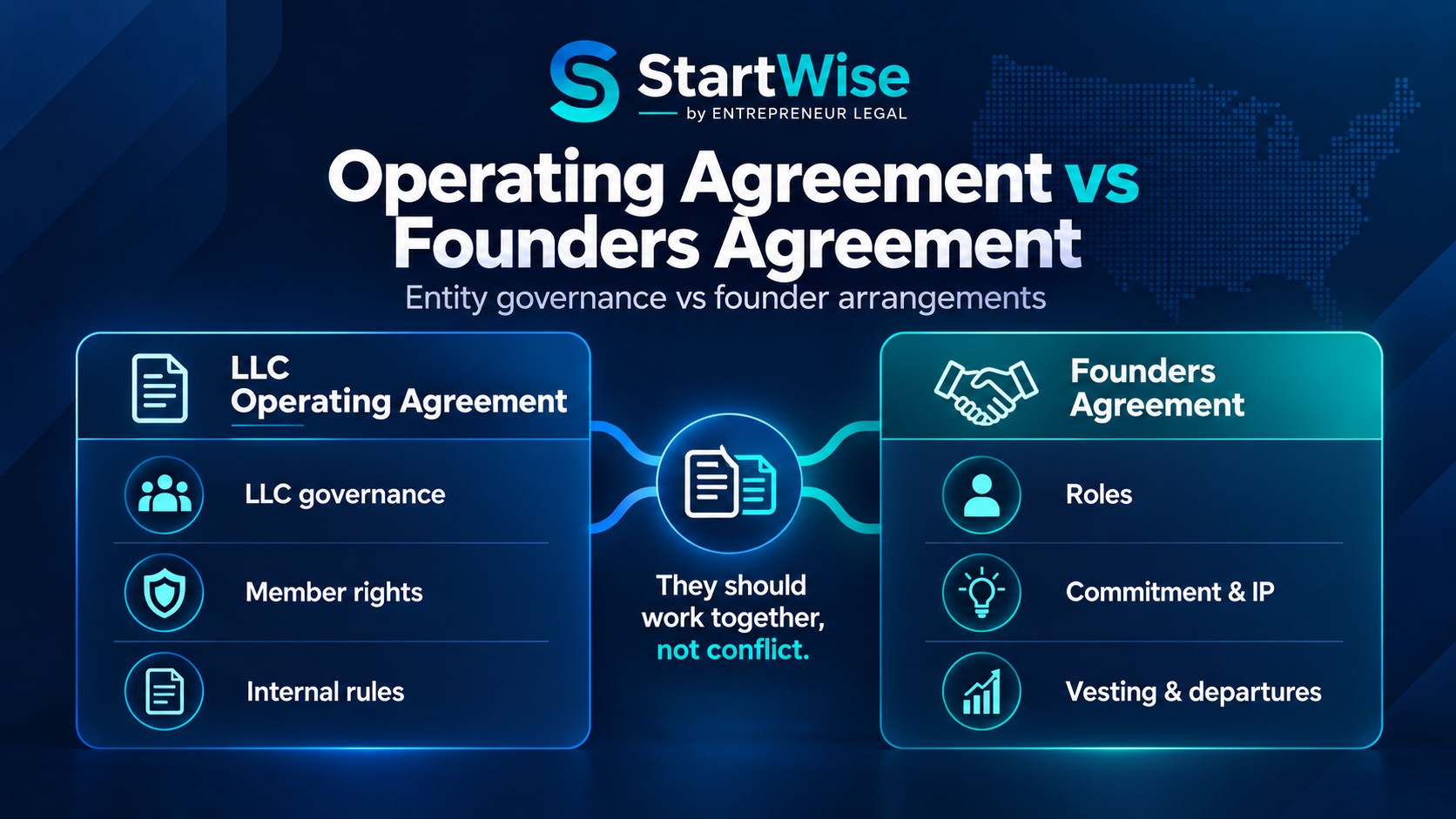
| Core purpose | Govern members, management, voting, economics, transfers, distributions, duties and LLC operations. | Record founder roles, commitments, founder-specific expectations, IP, vesting concepts, leaver and dispute arrangements. |
| Who uses it? | LLC members/managers. | Founders across entity types where a separate founder contract is useful. |
| Does it create/issue equity by itself? | It can govern LLC interests, but formation, admission, contributions and records still matter. | No; contractual promises must align with actual stock/membership-interest implementation. |
| Can both exist? | Yes. | Yes, but overlap must be reconciled. |
| Main risk | Using a generic state form that ignores the formation state or mandatory limits. | Recording founder promises that conflict with the entity’s governing documents or cap table. |
Founder scenario: three founders, one LLC, two documents that could conflict
Three founders form a Delaware LLC. They agree to 40/35/25 economics, majority approval for normal business decisions, unanimous approval for a company sale, and a reduced economic outcome if the part-time founder leaves before becoming full-time. A founder-side document records those expectations. A separately drafted operating agreement uses a different transfer rule and a different voting threshold.
The problem is not that one document is “wrong.” The problem is that the legal architecture is inconsistent. The operating agreement should govern the LLC in a way that implements the chosen economics and governance, while any separate founders agreement should address founder-specific obligations without contradicting the entity document.
1. An operating agreement is an LLC document
The operating agreement is tied to the limited liability company and the law of the state where it is formed. It commonly addresses members, contributions, economic interests, management, voting, distributions, transfer restrictions, admission of new members, records, duties, indemnification, dissolution and other internal rules.
That does not mean every state treats the agreement the same way. State law can determine whether the agreement must be written, what default rules apply when it is silent, and which statutory duties or rights can or cannot be varied.
2. Delaware gives LLC agreements unusually broad contractual significance
Delaware is a useful example. Section 18-101 of the Delaware LLC Act defines a limited liability company agreement broadly and recognizes written, oral or implied agreements. Section 18-1101 states Delaware’s policy of giving maximum effect to freedom of contract and enforceability of LLC agreements, while preserving statutory limits such as the implied covenant of good faith and fair dealing.
That makes the operating agreement central to a Delaware LLC’s governance, but it does not mean Delaware language should be copied into another state’s LLC without review.
3. New York requires a written operating agreement
New York illustrates a different statutory design. LLC Law § 417 states that members shall adopt a written operating agreement addressing the company’s business, affairs and the rights, powers, preferences, limitations or responsibilities of members, managers, employees or agents, subject to the statute and articles of organization. The statute allows the agreement before, at or within 90 days after filing the articles, but not to become effective before formation.
That is a concrete reason the FAQ “does every LLC need a written operating agreement?” cannot be answered nationally.
4. California identifies both the operating agreement’s role and nonwaivable limits
California Corporations Code § 17701.10 states that the operating agreement governs relations among members, member/company relations, manager rights and duties, the LLC’s activities and amendment mechanics, but also lists provisions that cannot be varied or can only be varied within statutory limits.
California therefore provides another reason to avoid treating a generic Delaware-style agreement as a nationwide governance solution.
5. A founders agreement focuses on the founder relationship
A founders agreement can address who is expected to work full-time, areas of responsibility, founder decision-making, confidentiality, founder-created IP, outside activities, conflicts of interest and related obligations subject to applicable state law, vesting concepts, departure expectations, dispute processes and what the founders intend to happen if circumstances change.
But a founders agreement is not a substitute for the entity’s actual governance and equity implementation. For a corporation, founder equity is not implemented merely by a founders agreement. Applicable corporate approvals, issuance records and separate equity documentation may be required; vesting, securities and tax consequences may also need separate analysis. For example, Delaware law separately addresses board-authorized stock issuance and the corporation’s stock ledger. For an LLC, membership interests, contributions, allocations, distributions, transfers and admission mechanics should be consistent with the operating agreement and state law.
6. Overlap is normal; contradiction is the problem
Voting, transfers, economics, founder departures and IP can appear in both an LLC operating agreement and a founders agreement. That overlap should be intentional. Decide which instrument controls each subject and use consistent definitions and thresholds. If one document allows a transfer with majority consent and another effectively requires unanimity, the conflict should be resolved before anyone relies on either.
7. Vesting and buy-back concepts can move the issue out of self-service drafting
Founder vesting, reverse vesting, repurchase or buy-back mechanisms can interact with current ownership, tax, securities, company/LLC law and financing expectations. A drafting tool can record a choice; it should not be used to invent the economic/legal structure when the founders have not decided it or do not understand the consequences.
8. Financing can change the governance architecture
Outside financing can introduce new consent rights, transfer restrictions, information rights, board or manager arrangements and new equity instruments. A founders agreement drafted at formation should not be assumed to remain the only governance document after institutional or sophisticated outside capital enters the business.
Decision table: which document or route fits?
| Situation | Likely starting point | Why |
|---|---|---|
| Multi-member LLC; state and governance choices settled | LLC Operating Agreement | Entity governance is the central need. |
| LLC founders also want personal commitment/leaver arrangements | Potentially both, carefully aligned | Founder-specific obligations can sit beside entity governance. |
| Corporation with founder vesting/IP issues | Corporate/equity documents + possible founders agreement | An LLC operating agreement does not apply. |
| Entity choice unresolved | Attorney/tax advice first | The document should follow the entity decision. |
| Complex vesting, repurchase, tax or financing | Attorney/tax support | The difficult question is legal/economic structure, not wording. |
A founder alignment checklist
- Confirm the entity type and formation state.
- Confirm the current cap table/member interests and how they were actually issued/admitted.
- Separate founder personal commitments from entity governance rules.
- Map voting/reserved matters and make thresholds consistent across documents.
- Map transfer restrictions and leaver consequences across documents.
- Identify founder-created IP and ensure any required assignments or other transfer steps to the entity are completed; for copyright, a transfer of ownership generally requires a signed writing.
- Treat vesting, repurchase, tax and financing mechanics as legal-implementation questions where material.
- Reconcile the operating agreement, founders agreement, cap table and later investor documents after material changes.
Common mistakes and consequences
| Mistake | Practical consequence |
|---|---|
| Choosing the document before choosing the entity | A corporation/LLC structure can be documented using the wrong legal instrument. |
| Copying a Delaware operating agreement for another state | Mandatory/default state rules may not match. |
| Putting founder equity percentages only in a private agreement | The company records and actual equity implementation may tell a different story. |
| Duplicating voting/transfer provisions inconsistently | The documents can produce contradictory governance outcomes. |
| Using self-service drafting to design complex vesting/tax | The wording may encode a structure the founders did not properly analyze. |
How StartWise® Drafting fits
StartWise currently includes a US LLC Operating Agreement and Founders’ Agreement. Where the entity and key commercial choices are already understood, guided questions can help organize the information and generate tailored first drafts with Drafting Notes.
StartWise does not choose the entity, determine tax treatment, implement complex equity, resolve fiduciary-duty design, structure financing or reconcile disputed founder rights. Those questions may require attorney and tax support before drafting.
Prefer a static Founders’ Agreement template?
If the founders have already determined that a Founders’ Agreement is the right document, the entity and core commercial choices are settled, and they are comfortable adapting a static form themselves, Entrepreneur Legal US also offers an Attorney-Drafted Founders’ Agreement Template on Etsy. This is a secondary self-service option for the Founders’ Agreement only. It does not replace an LLC Operating Agreement, stock or membership-interest implementation, tax work, securities compliance or other entity-governance steps.
Frequently asked questions
Does every US LLC need a written operating agreement?
There is no single national answer. New York, for example, requires members to adopt a written operating agreement under LLC Law § 417, while Delaware recognizes LLC agreements that can be written, oral or implied. Check the formation state.
Can a founders agreement replace an LLC operating agreement?
It should not be assumed to do so. The operating agreement is the LLC’s governance contract under state law. A founders agreement can address founder-specific arrangements but should align with the entity’s governing documents.
Can an LLC have both?
Yes. The key is deliberate overlap and consistency. Voting, transfer, economics and founder-leaver provisions should not point in different directions.
Does a founders agreement issue stock or membership interests?
Not by itself in every situation. Actual equity implementation can require entity-specific approvals, subscription/purchase or admission mechanics, records, tax work and other steps.
What if we have not chosen LLC vs corporation?
Resolve the entity question before treating the problem as document selection. Entity choice can affect tax, governance, equity mechanics and future financing.
Author and review information
Author / legal reviewer: Gabriel C. Mbanefo, Esq. - Attorney admitted to the New York State Bar and Solicitor of the Senior Courts of England and Wales; President, Law Offices of Gabriel C. Mbanefo, P.C. d/b/a Entrepreneur Legal.
Planned publication date: 8 October 2026.
Current source-check date: 19 September 2026.
Jurisdiction statement: General US entity/governance information. Delaware, New York and California are illustrative state examples; other states differ. Not legal or tax advice.
Official sources and related Entrepreneur Legal resources
- Delaware LLC Act § 18-101 - definition of LLC agreement.
- Delaware LLC Act § 18-1101 - freedom of contract.
- New York LLC Law § 417 - written operating agreement.
- California Corporations Code § 17701.10 - operating agreement governance and limits.
Choose the right next step
Draft through StartWise. Review for less.
Explore the current guided US documents, or contact Entrepreneur Legal US where your matter requires review, consultation or bespoke support.