Entrepreneur Legal US · Insight
1099 vs W-2 for Startups: Worker Classification Is More Than a Tax Form
By Gabriel C. Mbanefo, Esq. - Attorney admitted to the New York State Bar and Solicitor of the Senior Courts of England and Wales; President, Law Offices of Gabriel C. Mbanefo, P.C. d/b/a Entrepreneur Legal.
At a glance: the form comes last
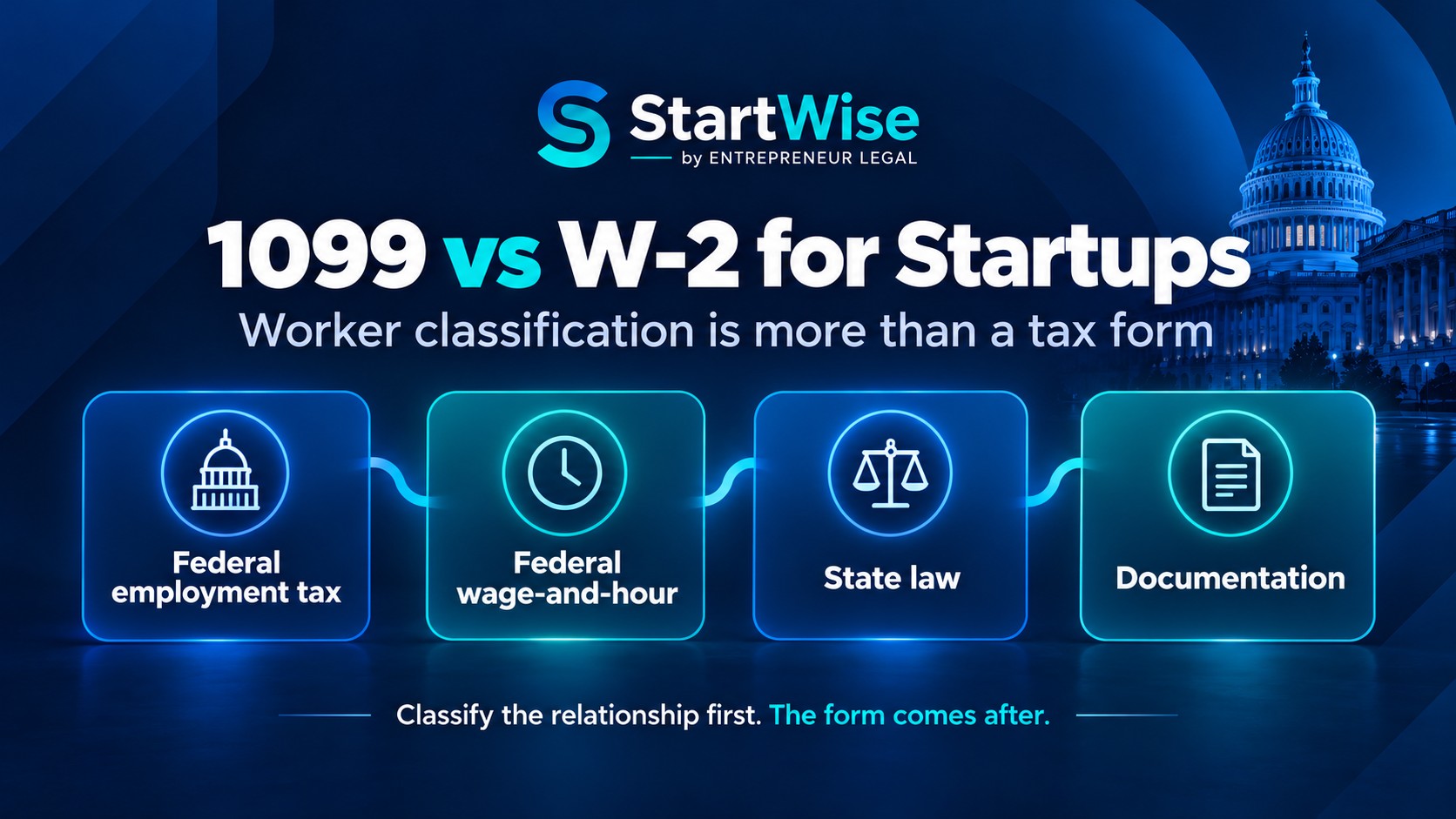
| Layer | Core question | Current source | Why founders care |
|---|---|---|---|
| Federal employment tax | Does the business have the right to control what will be done and how? | IRS common-law framework / Publication 15-A. | A 1099/W-2 reporting decision follows the relationship. |
| Federal FLSA | Is the worker economically dependent on the business or in business for themselves? | 29 C.F.R. Part 795 + DOL current enforcement/rulemaking materials. | Minimum-wage/overtime coverage analysis is separate from tax. |
| State law | What test applies where the worker performs services and for the specific statute? | California ABC/Borello examples; New York control analysis, among others. | A worker can face different state-law standards. |
| Documentation | What agreement matches the resolved relationship? | Employment or contractor agreement. | The contract records the relationship; it does not create legal status. |
Founder scenario: the “contractor” who runs part of the company
A Delaware startup engages a California-based head of growth as a “contractor.” The person works exclusively for the startup, manages two employees, uses the company’s systems, is expected online during fixed core hours, needs approval for time off and is paid the same amount every two weeks. The contract says independent contractor and the company plans to issue Form 1099-NEC.
Those labels do not answer the classification question. The startup must analyze federal tax treatment, federal FLSA status and applicable California law. If those analyses point toward employee treatment, the correct response is not to strengthen the contractor wording; it is to change the legal/operational structure and payroll/documentation accordingly.
1. IRS federal tax classification: control and independence come before the form
IRS Publication 15-A states that a business must know the relationship before it can know how to treat payments. Under the common-law framework, all facts bearing on control and independence matter, commonly grouped as behavioral control, financial control and the type of relationship. No single factor automatically decides the result.
This is why regular payments, a signed contractor agreement or Form 1099-NEC are evidence of how the parties treated the relationship, not legal shortcuts that override the actual facts.
2. FLSA classification is a separate federal analysis
Federal wage-and-hour classification under the FLSA uses an economic-reality framework rather than the IRS common-law tax test. The 2024 regulation in 29 C.F.R. Part 795 remains in effect, including for private litigation. DOL separately states that WHD is not applying the 2024 rule’s analysis in current investigations and is using separate enforcement guidance while the 2026 replacement rulemaking remains pending.
3. The 2026 DOL proposal is not current law as of this review
On February 26, 2026, DOL proposed to rescind the 2024 rule and replace it with a streamlined five-factor economic-reality analysis with two “core” factors: control and opportunity for profit or loss. The comment period closed April 28, 2026. As of 19 September 2026, DOL’s own rulemaking page still describes the action as a proposal. The October article must therefore be checked again before publication rather than predicting the final rule.
4. California shows why state law can materially change the answer
California Labor Code §§ 2775 et seq. apply the ABC test to many relationships, subject to statutory exceptions and alternative standards. Under the ABC test, the hiring entity generally must establish that the worker is free from control/direction, performs work outside the usual course of the hiring entity’s business, and is customarily engaged in an independently established trade, occupation or business.
California DIR expressly states that a written independent-contractor agreement, payroll withholding choice or Form 1099 does not determine employment status. That makes California a useful example of why national contractor paperwork should not be chosen before state analysis.
5. New York provides a different state-law example
New York does not simply replicate California’s ABC test for all purposes. In the unemployment-insurance context, the New York Court of Appeals in Matter of Vega and NYDOL materials apply a fact-specific analysis focused on supervision, direction and control. Other New York statutes can also impose specific rules for particular relationships.
The point is not that New York is “easier” or “harder.” It is that the governing test depends on the law being applied, so a multi-state startup should identify the worker’s location and each relevant statutory regime.
6. Worker location matters more than incorporation-state instinct
A Delaware incorporation does not make Delaware worker-classification law the only relevant state law. Wage, unemployment, workers’ compensation, tax, leave and other state rules can attach based on where services are performed or where the employment relationship is centered.
7. Misclassification can affect more than tax forms
Potential consequences can include federal employment-tax liability, wage-and-hour claims, state wage remedies, unemployment and workers’ compensation consequences, benefit disputes, penalties or other state-law exposure depending on the facts and statute. The exact remedies are jurisdiction-specific, which is another reason to avoid a single nationwide penalty statement.
8. A practical startup classification process
- Map where the worker actually performs services and which state/local rules may apply.
- Describe the real operating model: control, schedule, supervision, tools, substitution, business risk, other clients, integration and duration.
- Apply the IRS federal employment-tax framework.
- Apply the current FLSA framework and recheck DOL rulemaking/enforcement status.
- Apply the relevant state tests and any industry/occupation exceptions.
- Resolve material uncertainty before onboarding or changing payroll treatment.
- Only then choose W-2/1099 reporting and the employment or contractor agreement.
- Reassess if the relationship changes over time.
9. How StartWise® Drafting fits after classification
StartWise currently includes an Independent Contractor Agreement. If the relationship has been reasonably classified as genuinely independent and the commercial arrangement is routine, guided questions can help document scope, fees, IP, confidentiality, risk and termination and generate a tailored first draft with Drafting Notes.
If the question is “should this person be W-2 or 1099?”, StartWise is not the first route. That is a classification/legal-advice question.
Common mistakes and consequences
| Mistake | Why it fails |
|---|---|
| “We will just 1099 them.” | The tax form follows classification; it does not create it. |
| Contract says contractor, practice looks employee-like | Actual facts matter under federal and state tests. |
| Using one state’s test nationally | State laws and statutory purposes can differ. |
| Checking IRS but not FLSA/state law | Different legal frameworks can produce different analyses. |
| Never reassessing a long relationship | A project relationship can evolve into a different factual model. |
Frequently asked questions
Does a 1099 mean someone is an independent contractor?
No. IRS and California guidance both make clear that tax reporting/labels do not themselves determine legal status.
Does the IRS test settle FLSA status?
No. Federal employment tax and the FLSA use different legal frameworks, and state law can differ again.
What is the current DOL test?
As of 19 September 2026, the 2024 regulation remains in effect, including for private litigation; WHD uses a separate enforcement position in current investigations; and the February 2026 replacement remains proposed. This answer must be rechecked immediately before the October publication date.
Can a startup use the same contractor policy in every state?
Not safely as a legal assumption. State classification tests, wage rules and other obligations can differ. The startup should map the worker’s location and the laws relevant to that relationship.
When should a startup get attorney advice?
When the worker is a core or senior role, highly controlled, long-term, exclusive, multistate, in a state with a materially different test, or where federal/state analyses are uncertain or point in different directions.
Author and review information
Author / legal reviewer: Gabriel C. Mbanefo, Esq. - Attorney admitted to the New York State Bar and Solicitor of the Senior Courts of England and Wales; President, Law Offices of Gabriel C. Mbanefo, P.C. d/b/a Entrepreneur Legal.
Planned publication date: 15 October 2026.
Current source-check date: 19 September 2026.
Choose the right next step
Classify first. Document second.
If worker status is uncertain, use Entrepreneur Legal US hiring/classification support before selecting the agreement. Once the relationship is reasonably supportable as genuinely independent, explore the current guided US documents through StartWise.