Entrepreneur Legal US · Insight
When Should a US Business Use an NDA?
By Gabriel C. Mbanefo, Esq. — Attorney admitted to the New York State Bar and Solicitor of the Senior Courts of England and Wales; President, Law Offices of Gabriel C. Mbanefo, P.C. d/b/a Entrepreneur Legal.
When an NDA may be appropriate
| Situation | Use an NDA? | Key point |
|---|---|---|
| Exploring a partnership or vendor deal | Often | Define the permitted purpose before detailed information is shared. |
| Sharing patent-sensitive technical information | Usually, before disclosure | Public disclosure can affect patent strategy; timing matters. |
| High-level investor pitch | Not always | Many investors will not sign early-stage NDAs; use staged disclosure. |
| Both sides exchange confidential information | Often mutual NDA | Mutuality should follow the real information flow. |
| Employee/contractor access to trade secrets | Often, with tailored terms | 18 U.S.C. § 1833(b) immunity/notice and applicable employment or contractor law must be considered. |
| Whistleblower/reporting concerns | NDA cannot lawfully block protected reporting | DTSA, SEC Rule 21F-17, Speak Out Act and state laws restrict attempts to silence protected conduct; the rules apply in different contexts. |
The founder problem: “we signed an NDA” is not the same as “the information is protected”
A founder shares a product roadmap, pricing model and customer pipeline with a potential channel partner. The parties sign a two-page NDA. Months later the information has circulated through affiliates, advisers and contractors. The agreement never defined who could receive it, what the recipient could use it for or how long obligations lasted. The signature existed; the confidentiality system did not.
1. Put the NDA in place before disclosure where possible
The NDA is most useful when it sets the rules before the recipient receives sensitive material. A later agreement may regulate future use, but cannot undo an earlier public disclosure. For potentially patentable inventions, timing is particularly important: qualifying inventor-originated US disclosures may benefit from a limited one-year grace period under 35 U.S.C. § 102(b), but many foreign jurisdictions provide no comparable grace period. Obtain patent advice before public disclosure rather than relying on that exception.
2. Define confidential information and permitted use
A useful NDA identifies protected information with enough clarity to operate: source code, technical plans, nonpublic financial information, customer data, pricing, supplier terms, security architecture or other specified categories. It should also define why the recipient may use the information. Restricting use can be as important as restricting disclosure.
3. Trade-secret law requires reasonable secrecy measures
The federal Defend Trade Secrets Act defines a trade secret around economic value from secrecy and reasonable measures to keep the information secret. An NDA can be one of those measures, but it should sit alongside access controls, restricted repositories, need-to-know permissions, data-room controls and disclosure records.
4. Federal law protects certain whistleblower disclosures
18 U.S.C. § 1833(b) gives qualifying immunity for confidential trade-secret disclosures to government officials or an attorney for reporting or investigating a suspected legal violation, and for specified sealed court filings. Employers must give notice of that immunity in agreements with employees governing confidential information; for this purpose, "employee" includes individual contractors and consultants. A compliant cross-reference to a supplied policy may satisfy the notice requirement.
Missing notice does not automatically void the agreement, but can bar DTSA exemplary damages and attorney fees against the individual who did not receive it.
5. SEC Rule 21F-17 protects direct SEC reporting beyond public-company employment
SEC Rule 21F-17(a) prohibits any person from impeding an individual's direct communications with SEC staff about a possible securities-law violation, including by enforcing or threatening to enforce an obstructive confidentiality agreement. The SEC explains that this restriction is not confined to public companies or to employer-employee arrangements. A commercial NDA, separation agreement or policy should not condition protected SEC communications on company permission or notification. The rule has specified exceptions for certain attorney-client representation information.
6. The Speak Out Act limits some pre-dispute gag clauses
The federal Speak Out Act, 42 U.S.C. § 19403, makes pre-dispute nondisclosure and nondisparagement clauses judicially unenforceable in sexual-assault and sexual-harassment disputes where an alleged violation of federal, state or tribal law is involved. It does not automatically void every commercial NDA or bar protection of legitimate trade secrets and proprietary information. More protective state and local rules may apply.
7. New York and California impose additional, different NDA limits
New York General Obligations Law § 5-336 restricts secrecy provisions in settlements involving discrimination, harassment or retaliation unless confidentiality is the complainant's preference and statutory conditions are satisfied. It also regulates certain employment and contractor clauses relating to future discrimination claims; some releases become unenforceable if prohibited penalties, forfeitures or disclaimers are imposed.
California Government Code § 12964.5 restricts workplace nondisparagement and separation terms that prevent disclosure of unlawful acts, with specified carve-outs and notice requirements; Code of Civil Procedure § 1001 separately restricts confidentiality of factual information in certain filed claims and settlements. These are illustrative, not interchangeable rules or a national standard. Obtain state-specific counsel for employment, separation and settlement drafting.
8. One-way vs mutual should follow the real disclosure
Use a unilateral NDA where one side is the true discloser. Use a mutual NDA where both sides genuinely expect to share sensitive information. Mutual language can create unnecessary compliance burdens when the flow is one-directional, while a unilateral form can be inadequate where both parties contribute proprietary material.
9. An NDA does not transfer intellectual property
Confidentiality and ownership are different legal jobs. An NDA can restrict use/disclosure but does not automatically assign copyright, patent rights, trademark rights or other IP. If ownership must move, use appropriate assignment language or a separate assignment that meets the applicable formalities.
10. Duration should match the information
There is no universal US rule that every NDA should last two, three or five years. Ordinary business information may lose sensitivity. Trade secrets can remain valuable only while secrecy is maintained. Draft duration and survival based on the information and governing state law rather than copying an arbitrary number.
Common NDA mistakes and consequences
| Mistake | Practical consequence |
|---|---|
| Signing after the important disclosure | Practical secrecy or patent strategy may already be compromised. |
| No permitted-purpose restriction | Recipient may argue it kept information secret while using it for an unintended purpose. |
| No representative controls | Information can spread beyond the people the founder expected. |
| Assuming NDA alone creates a trade secret | Reasonable operational secrecy measures still matter. |
| Overbroad employee whistleblower language | Federal DTSA/SEC and state public-policy restrictions can be triggered. |
| Assuming NDA transfers IP | Ownership can remain with the creator. |
| Treating a mutual NDA as automatically safer | Unnecessary restrictions can arise when only one party discloses information. |
| Using an employment or settlement NDA to suppress harassment reporting | Speak Out Act and applicable state restrictions may make provisions unenforceable. |
| Assuming SEC reporting restrictions apply only to public companies | Rule 21F-17 prohibits impediments by any person in its scope. |
How StartWise® Drafting fits
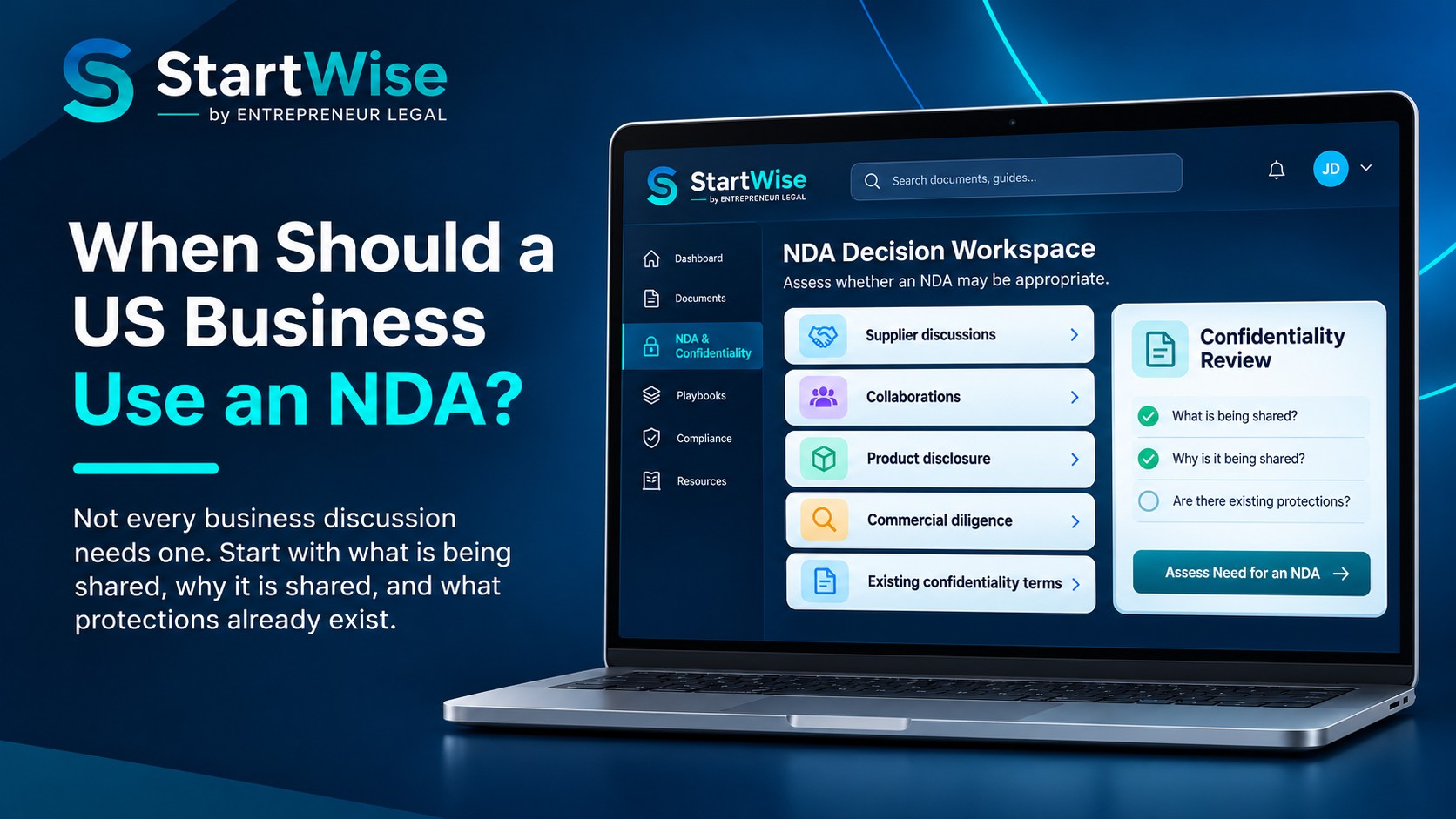
For a standard business-to-business NDA, StartWise can help with the drafting step. Choose the NDA, answer guided questions, generate a tailored first draft and review any Drafting Notes. Drafting Notes may flag assumptions or points to confirm but are not legal advice.
Use attorney support where the disclosure is patent-sensitive, already disputed, unusually valuable, related to employee or contractor status, a separation or settlement, securities-law reporting, New York/California statutory restrictions, cross-border rights or urgent enforcement. An ordinary commercial NDA should not be reused as an employment-claims or whistleblower gag clause.
Static-template alternative (only for a straightforward one-way disclosure)
Where the parties already know that only one side will disclose confidential information and the arrangement is routine, Entrepreneur Legal US also offers a downloadable unilateral NDA with drafting instructions. It is a static file, not guided drafting or an attorney review. Check its exclusions, duration, protected-reporting carve-outs and governing state. Do not treat it as suitable by default for employment, separation, litigation settlements, sensitive patents or complex confidentiality disputes.
Verified Etsy listing: Entrepreneur Legal US Unilateral NDA (US).
Frequently asked questions
Do I need an NDA before every business conversation?
No. Use NDAs selectively where genuinely sensitive information must be disclosed and the recipient does not already owe adequate confidentiality obligations.
Will investors sign an NDA?
Some may, but many professional investors decline early-stage NDAs. Founders often use staged disclosure instead.
Does an NDA make information a trade secret?
No. Federal trade-secret protection depends on economic value from secrecy and reasonable measures to maintain secrecy.
Can an NDA stop someone from reporting a violation to the government?
Not universally. Federal law protects specified disclosures, including DTSA whistleblower immunity and SEC communications under Rule 21F-17.
Does an NDA transfer IP ownership?
No. Ownership and confidentiality are distinct. An assignment may be required where rights need to move.
Does the Speak Out Act invalidate every NDA?
No. It limits judicial enforcement of certain clauses agreed before a sexual-assault or sexual-harassment dispute arises. Ordinary trade-secret and proprietary-information protection can remain available, subject to other law.
Are employee and settlement NDAs treated the same in every state?
No. New York and California, among other states, impose particular restrictions and procedures. A standard commercial NDA should not be assumed to satisfy employment, separation or settlement law.
Does a missing DTSA immunity notice make the whole NDA invalid?
Not automatically. Under 18 U.S.C. § 1833(b), the notice omission can prevent an employer obtaining DTSA exemplary damages and attorney fees against an individual who was not given the required notice.
Author, legal-review and update information
Author / reviewer: Gabriel C. Mbanefo, Esq. — Attorney admitted to the New York State Bar and Solicitor of the Senior Courts of England and Wales; President, Law Offices of Gabriel C. Mbanefo, P.C. d/b/a Entrepreneur Legal. Approved biography / profile: https://us.entrep.legal/about/
Planned publication date: 5 November 2026.
Current source-check date: 16 October 2026 (selected statutes, SEC/USPTO guidance and StartWise/Etsy routes checked; publication-day recheck still required).
Jurisdiction statement: General United States information. Federal protections and illustrative New York / California state-law requirements are identified separately; no 50-state analysis. The applicable state, relationship and disclosure purpose may change the answer. Not legal advice.
Sources and related Entrepreneur Legal resources
- 18 U.S.C. § 1833(b) — DTSA immunity and notice.
- 18 U.S.C. § 1839 — Federal trade-secret definition.
- 17 C.F.R. §240.21F-17.
- USPTO — Patent grace period and filing abroad.
- Entrepreneur Legal US StartWise Access.
- Speak Out Act, 42 U.S.C. § 19403.
- New York General Obligations Law § 5-336.
- California Government Code § 12964.5.
- California Code of Civil Procedure § 1001.
- SEC — Whistleblower protections and Rule 21F-17.
- Entrepreneur Legal US — What Legal Documents Does a US Startup Need?
Choose the right next step
Draft through StartWise. Review for less.
Explore the current guided US documents, or contact Entrepreneur Legal US where your matter requires review, consultation or bespoke support.