Entrepreneur Legal US · Insight
Content Policy vs Acceptable Use Policy: What Is the Difference?
By Gabriel C. Mbanefo, Esq. — New York attorney and Solicitor (England and Wales).
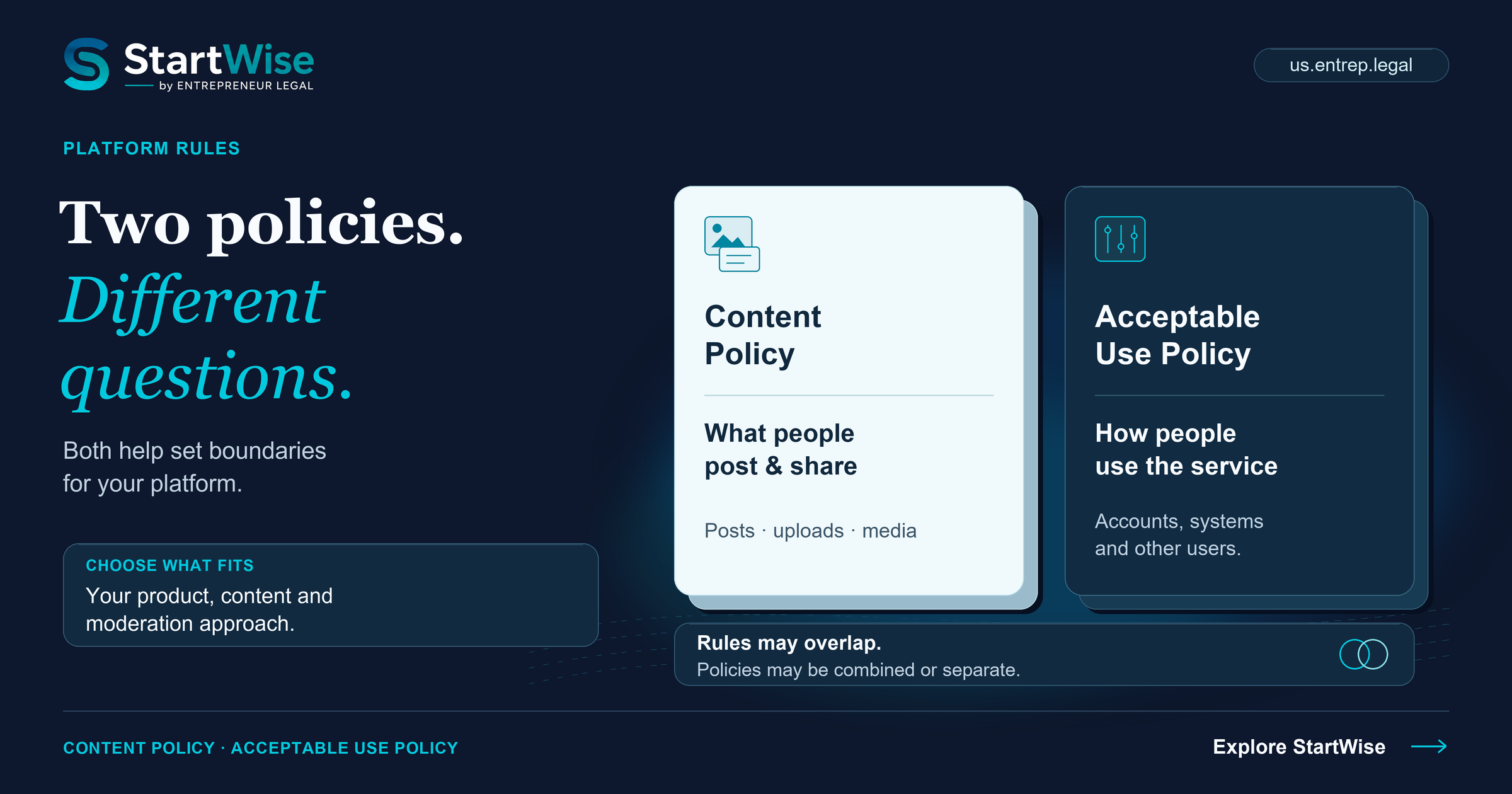
Content Policy vs Acceptable Use Policy at a glance
| Question | Content Policy | Acceptable Use Policy |
|---|---|---|
| Main focus | Rules for user posts, listings, reviews, profiles, photos, messages and moderation. | Rules for the use of accounts, APIs, network resources, transactions and security. |
| Typical issues | IP claims, unlawful images, impersonation, harassment, review standards and restricted user content. | Malware, spam, automated scraping, account sharing, prohibited sales, fraud and interference. |
| Enforcement | Content removal, labeling, visibility limits, warnings and a complaint or appeal process. | Rate limits, access restrictions, suspension, account termination, API revocation and evidence preservation. |
| Federal law overlay | DMCA §512, TAKE IT DOWN Act, FTC review rules, COPPA and §230 may matter depending on the service. | Computer misuse, deceptive practices, privacy and other relevant federal/state laws may apply. |
| Can one document combine them? | Yes. Clearly define restricted content, reporting, decisions and review mechanisms. | Yes. Keep security/transaction restrictions and enforcement measures discoverable and consistent. |
| Who should read it? | Anyone creating, uploading or sharing material. | All users, developers, sellers, integrators and account holders, as relevant. |
| Relationship to Website Terms | May be a standalone policy or a clearly incorporated portion of Website Terms. | May be standalone or incorporated, subject to valid notice/assent and consistent remedies. |
Explore the available US policy documents in StartWise; use attorney support if the platform must resolve mandatory removal, children’s-privacy, high-risk or state-specific obligations before drafting.
The founder problem: the rules look complete until the first enforcement decision
A community platform launches with a paragraph saying “do not post illegal or offensive content.” Six months later it must decide whether to remove a seller listing, suspend a user scraping thousands of profiles, respond to a copyright notice and handle an appeal from a creator. One generic rule did not tell the team what was prohibited, who could act or what process should follow.
1. Content Policy regulates publication and communication
A Content Policy can define prohibited categories of user-generated posts, reviews, listings, images and messages; IP complaints; impersonation; harassment; nonconsensual intimate images; and any content restrictions genuinely relevant to the product. Identify who the rule governs, how the content will be reported, who can act and what appeal or urgent escalation is available. A policy should not promise removal or monitoring capabilities the platform does not operate.
2. Acceptable Use Policy regulates use of the service more broadly
An AUP regulates behavior that may not involve publishing content: malware, probing security, credential theft, excessive automated requests, scraping, spam, circumvention, prohibited transactions, service interference or abuse of APIs. Define the prohibited act and the proportionate responses, including warnings, rate limits, feature restrictions and termination, with a practical evidence-preservation process.
For the related contractual setting, see Entrepreneur Legal US: Website Legal Requirements in the US and Commercial Agreements (US).
3. The documents can overlap without being duplicates
Posting a phishing link may violate both documents. One policy can combine them if users can find the relevant rule, the enforcement powers are consistent and the Website Terms clearly identify how the policy binds users. Align the policies with account sign-up notices, product restrictions, any Privacy Policy and actual moderation practices. Clear incorporation and assent matter under applicable state contract law.
4. DMCA compliance is operational
For a service seeking relevant 17 U.S.C. §512 copyright safe harbors, policy text alone is insufficient. Depending on the safe harbor, the provider may need an accessible designated-agent contact and current registration with the US Copyright Office (renewed at least every three years), a properly adopted and reasonably implemented repeat-infringer policy, expeditious action on qualifying notices, a counter-notification and restoration process, and compliance with other applicable statutory conditions. These steps do not automatically immunize a platform, and not every service qualifies for the same safe harbor.
5. Section 230 is not a clause
Section 230 can protect qualifying interactive-computer-service providers from certain claims treating them as the publisher or speaker of third-party information, subject to statutory language and case law. It does not generally foreclose federal criminal enforcement, intellectual-property law, specified sex-trafficking claims or the application of all consistent state laws. A platform’s own creation or development of content may change the analysis. Contract wording cannot create Section 230 immunity.
6. Enforcement should reflect product capabilities
Before making promises, map each restriction to a real decision-maker and technical control: who receives a report, what evidence is preserved, when an urgent hold applies, who approves removal or suspension, whether a user can appeal, and which complaints must go to counsel or law enforcement. Retention, notification and data protection practices must match what the service can lawfully and practically operate.
7. High-risk content categories need separate analysis
Children’s services, nonconsensual intimate imagery, medical/health claims, financial promotions, regulated goods, sexual content, threats, copyright-heavy creator platforms and multistate or international services can trigger obligations beyond these documents. Do not assume a broad Content Policy resolves the underlying classification, licensing, reporting or urgent-removal requirements.
For complex platform regulations and disputed enforcement matters, see Entrepreneur Legal US: Corporate and Regulatory Compliance.
8. TAKE IT DOWN Act: covered platforms need a real removal channel
Since 19 May 2026, covered online platforms under the federal TAKE IT DOWN Act have had to provide a clear process for reports of covered nonconsensual intimate imagery, including certain digitally created images. Upon a valid removal request, a covered platform must remove the content within 48 hours and make reasonable efforts to remove known identical copies. Check statutory coverage, required notices, safe handling of reports and how urgent cases are escalated. This is a separate duty from copyright takedown or ordinary policy enforcement.
9. Consumer reviews require distinct integrity rules
Where a service solicits, hosts or promotes product or service reviews, distinguish permitted moderation (such as filtering off-topic, fraudulent or abusive content) from misleading review manipulation. The FTC Consumer Reviews and Testimonials Rule addresses fake or false reviews, undisclosed insider reviews, incentives conditioned on sentiment, certain review suppression and other practices. Mere hosting of third-party reviews does not by itself create an affirmative duty under that rule to investigate each review; liability depends on the platform’s own conduct and the specific legal provision.
10. Children’s services need a COPPA analysis
The Children’s Online Privacy Protection Act and amended FTC COPPA Rule may apply when an online service is directed to children under 13 or has actual knowledge of collecting personal information from children under 13. Where applicable, obligations can include privacy notices, verifiable parental consent, restrictions on data use, security and retention controls. Most amended-rule compliance requirements have applied since 22 April 2026. A Content Policy or AUP cannot replace the required privacy and product controls.
11. New York illustrates state-specific moderation transparency
New York’s Stop Hiding Hate Act requires covered social-media businesses operating in the state with more than $100 million in annual gross revenues to publish accessible terms-of-service information and make specified twice-yearly reports to the New York Attorney General about content policies and enforcement. It is not a requirement imposed on every startup or every website. The legislation has been litigated; confirm applicability and current court orders or enforcement arrangements before advising a particular platform.
12. Coordinate the policies with the product and Website Terms
Identify the legal operator, covered users and services; align Content Policy and AUP definitions with Website Terms and any marketplace/seller rules; explain reporting and enforcement channels; verify consent or incorporation into the contractual relationship; and align promises with Privacy Policy, evidence handling, appeal procedures and relevant statutory complaint mechanisms. Internal moderators need practical instructions that can be followed consistently, not only public-facing prohibitions.
Operational checklist: decisions and evidence before publication
| Check | Evidence / action | What can go wrong |
|---|---|---|
| Content and users | Map uploads, messages, reviews, listings, minors and account types. | Rules may leave key product activity uncovered. |
| Conduct and technology | Identify scraping, spam, API, fraud, and credential misuse; confirm product controls. | Prohibited conduct cannot be detected or acted on consistently. |
| Statutory reports | Determine coverage of DMCA, TAKE IT DOWN Act, FTC reviews and COPPA; assign responsible staff. | Mandatory removal or privacy duties can be missed. |
| Moderation decisions | Set thresholds, decision authority, safety escalation, records and communications. | Inconsistent enforcement, inadequate response to urgent harm. |
| Terms and assent | Check policy incorporation, effective dates, notice and acceptance where required. | Policy terms may not bind intended users. |
| State/cross-border reach | Identify relevant states, platform size and international audiences. | A single national policy can overlook jurisdiction-specific rules. |
| Review and maintenance | Assign update owner, review cadence and repeat-infringer/DMCA-agent renewal. | Outdated policy or expired statutory designations. |
Common mistakes
| Mistake | Practical consequence |
|---|---|
| One vague rule for all misuse | Moderators lack consistent criteria. |
| DMCA language but no process | Safe-harbor conditions may not be satisfied. |
| Assuming Section 230 is universal immunity | Important exclusions and separate laws remain. |
| Rules inconsistent with product controls | The platform promises enforcement it cannot operationalize. |
| No appeal/escalation framework | Inconsistent decisions and avoidable user disputes. |
| Assuming a generic DMCA clause completes safe-harbor requirements | Agent registration, notice and counter-notice systems or repeat-infringer controls may be missing. |
| Treating a TAKE IT DOWN request as an ordinary copyright complaint | A covered platform may miss the statutory 48-hour obligation. |
| Promising review neutrality but manipulating negative reviews | FTC deceptive-review or review-suppression exposure. |
| Copying a universal policy for children or heavily regulated users | COPPA and other sector-specific operational requirements may remain unmet. |
| Ignoring Website Terms acceptance and state-law differences | Published restrictions may be ineffective or inconsistent with contractual and statutory duties. |
How StartWise® Drafting fits
For a reasonably standard service, StartWise® Drafting can help create Content Policy and Acceptable Use Policy tailored first drafts through document-specific guided questions, subject to current library availability. Drafting Notes may flag assumptions and implementation decisions; they do not classify illegal content, determine statutory coverage or complete required moderation systems.
A static editable template may suit a user who already understands the platform’s rules and can adapt the terms independently, but a policy title or template is not a substitute for operational compliance. Use attorney support first for DMCA system design, TAKE IT DOWN Act coverage, children’s services, high-risk enforcement, state-law uncertainty or material disputes.
Create a free StartWise account to explore available documents; drafting credits are required to generate a document. Confirm Content Policy and Acceptable Use Policy availability immediately before publication. See StartWise US Access.
Frequently asked questions
Do I need both a Content Policy and an Acceptable Use Policy?
Not always. They can be combined if the rules remain clear, but content and broader service misuse are different functions.
Does a Content Policy give my platform Section 230 protection?
No. Section 230 may provide defenses within its statutory scope, but it excludes or preserves specified categories including intellectual-property law and federal criminal law. The written policy does not establish immunity.
Does mentioning DMCA in my Terms create safe-harbor protection?
No. Section 512 safe harbors depend on applicable statutory conditions and operational procedures, which can include an active designated agent, a repeat-infringer policy, notices, and counter-notifications.
Should users be allowed to appeal moderation decisions?
A workable review or appeal path can improve consistency, but its design depends on legal obligations and the service’s risks. Urgent safety removals may require a different process from ordinary enforcement disputes.
Can StartWise® decide which content is illegal?
No. StartWise® is guided drafting, not content classification or legal advice.
What is the TAKE IT DOWN Act deadline?
For a covered platform receiving a valid request concerning covered nonconsensual intimate imagery, the federal statute generally requires removal within 48 hours and reasonable efforts concerning known identical copies. The statutory coverage and request requirements must be checked.
Does the FTC rule require us to check every hosted consumer review?
No. Mere hosting of third-party reviews does not itself impose a duty under the Reviews and Testimonials Rule to investigate each review. The service’s own conduct, incentives, suppression practices and representations still matter.
Do New York content-reporting rules apply to every startup?
No. The Stop Hiding Hate Act has a revenue threshold above $100 million for covered social-media companies operating in New York. Smaller platforms may face other applicable laws; confirm current litigation and enforcement position for the relevant business.
Author, legal-review and update information
Author / attorney reviewer: Author: Gabriel C. Mbanefo, Esq., New York attorney and Solicitor (England and Wales). Biography: https://us.entrep.legal/about/. Attorney reviewer: [VERIFY ACTUAL REVIEWER AND APPROVED CREDIT].
Planned publication date: 19 November 2026.
Current source-check date: 15 November 2026 (editorial source verification; this does not establish attorney sign-off).
Jurisdiction statement: General US federal platform-law information plus selected New York moderation-transparency law; state contract, privacy and consumer law can vary. Not legal advice and not a company-specific or 50-state analysis.
Sources and related Entrepreneur Legal resources
- 47 U.S.C. §230 — federal third-party-content liability and exceptions
- 17 U.S.C. §512 — DMCA online-service-provider safe harbors
- US Copyright Office — Section 512 takedown and counter-notification guidance
- US Copyright Office — designated-agent directory, renewal and FAQs
- FTC — Complying with the TAKE IT DOWN Act (effective 19 May 2026)
- FTC — Consumer Reviews and Testimonials Rule Q&A (16 C.F.R. Part 465)
- FTC / Federal Register — amended COPPA Rule (16 C.F.R. Part 312)
- New York Attorney General — Stop Hiding Hate Act, reporting and threshold
- Entrepreneur Legal US — Website Legal Requirements in the US
Choose the right next step
Draft through StartWise. Review for less.
Explore the current guided US documents, or contact Entrepreneur Legal US where your matter requires review, consultation or bespoke support.