Entrepreneur Legal US · Insight
Do US Startups Need a Privacy Policy?
United States. Federal rules are identified separately from state-specific rules; state law and business model may materially change the answer.
Privacy policy requirements at a glance
| Startup situation | Privacy policy/notice issue | Typical action |
|---|---|---|
| Commercial website/app collecting PII from California consumers | CalOPPA can require a conspicuously posted privacy policy. | Publish and follow an accurate privacy policy. |
| Business meeting CCPA coverage thresholds | CCPA privacy notices/rights and policy disclosures may apply. | Build CCPA-specific notices and rights processes. |
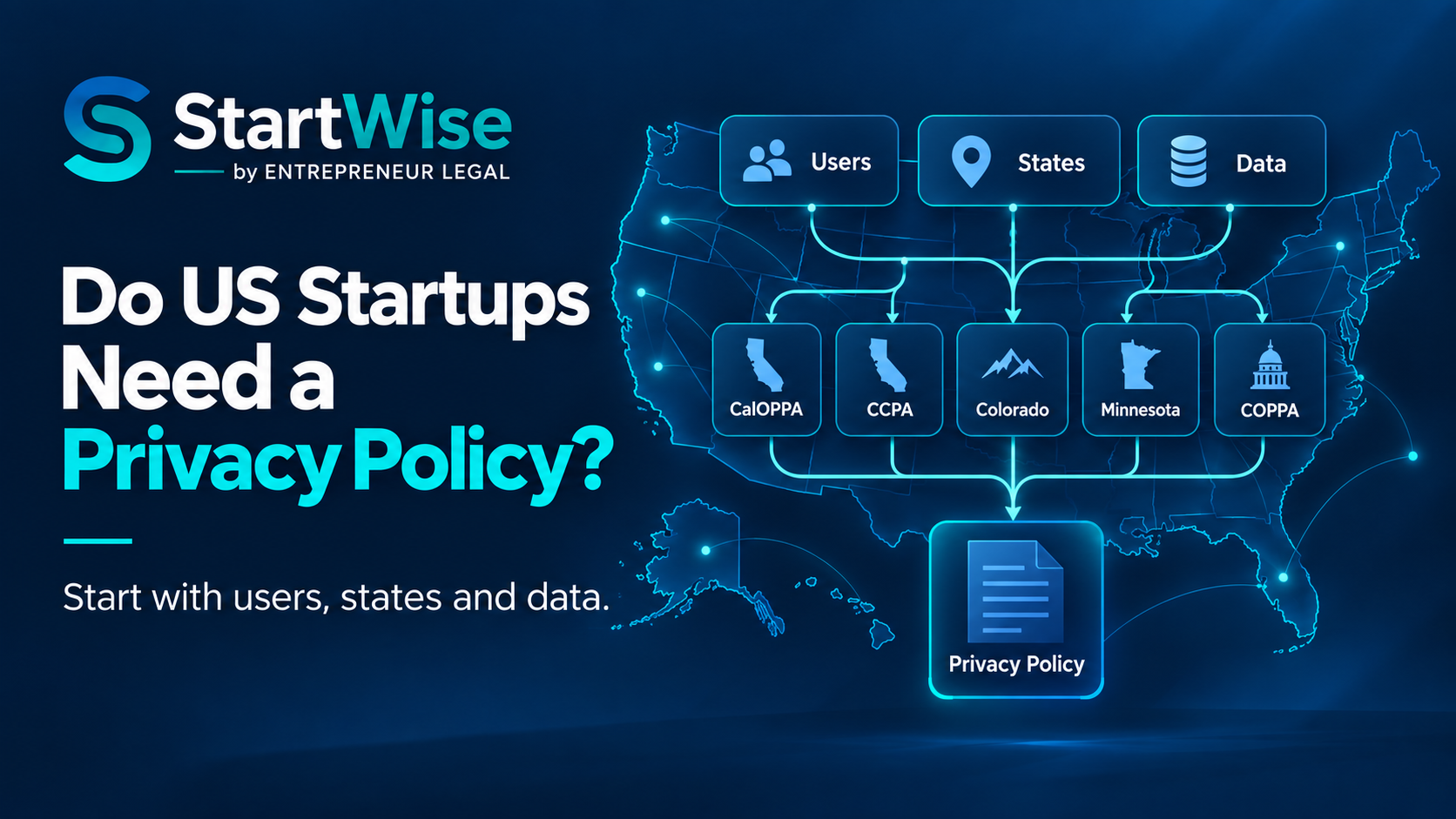
| Users in Colorado, Minnesota or other states with comprehensive privacy laws | Covered state laws can require detailed privacy notices, consumer-rights processes and opt-out mechanisms. | Check each law’s thresholds/exemptions and implement the state-specific disclosures and operational controls that apply. |
| Child-directed service or actual knowledge of data from under-13 users | COPPA can apply federally. | Privacy policy + parental notice/consent/security/retention controls. |
| Health, financial or other regulated data | Sector laws may add separate privacy notices and controls. | Get sector-specific legal analysis. |
| General nationwide startup with users across states | Several state privacy laws may be relevant over time. | Maintain a state-law applicability matrix and update policy/rights processes. |
The founder problem: “we are a Delaware company” does not answer privacy-law scope
A Delaware-incorporated startup launches an app used nationwide. It collects names, emails, device identifiers, purchase history and analytics data. Marketing assumes the privacy question is governed by Delaware because that is where the company was formed. Privacy laws can instead turn on where consumers live, what data is collected, the business’s size/activity and whether the service is in a regulated sector.
The policy should be the public explanation of an actual privacy program, not a form chosen by incorporation state.
1. There is no single omnibus federal privacy-policy requirement for every startup
US privacy law is a patchwork. Some federal laws regulate specific sectors or populations; states create broader privacy and online-policy duties. That means one generic statement - “US law requires a privacy policy” - is too broad. The more accurate answer is that many startups will be legally required to provide privacy notices because of the laws that apply to their users, data or sector.
2. CalOPPA is a direct website/privacy-policy example
The California Attorney General explains that the California Online Privacy Protection Act requires operators of commercial websites and online services that collect personally identifiable information about California consumers to conspicuously post a privacy policy. The policy must contain specified information and the operator must comply with it.
This can matter to a startup located outside California if it operates a qualifying site or service used by California consumers.
3. The CCPA adds a broader privacy-rights framework for covered businesses
The CCPA, as amended, applies to businesses that meet its statutory scope and provides California consumers with privacy rights and disclosure requirements. Covered businesses need more than a generic policy: they may need notices at collection, rights-request processes and opt-out/limit mechanisms depending on their practices.
Updated CCPA regulations took effect on January 1, 2026. For businesses to which the relevant provisions apply, the current framework can also include risk assessments, annual cybersecurity audits and consumer rights concerning certain uses of automated decisionmaking technology (ADMT). Those requirements sit behind the public-facing policy and should be assessed separately from the threshold question of whether a policy or notice is required.
A startup that is below coverage thresholds today should still monitor growth and business-model changes rather than assume the current position is permanent.
4. California is only one example of state privacy law
Colorado and Minnesota illustrate why a nationwide startup should not treat California wording as a complete multistate solution. The Colorado Privacy Act requires covered controllers to provide privacy notices and honor consumer rights that can include opt-outs from sale and targeted advertising, including recognized universal opt-out mechanisms. Minnesota’s Consumer Data Privacy Act, effective since July 31, 2025, requires covered controllers to provide a clear privacy notice containing specified information such as data categories, purposes, consumer rights, third-party categories and retention policies.
Neither law applies to every startup: coverage thresholds, exemptions, data types and business activities matter. These are examples of the state-by-state differences a growing startup should track rather than a complete 50-state survey.
5. COPPA can impose federal duties for children under 13
FTC guidance states that COPPA applies to operators of commercial child-directed websites/online services that collect personal information from children under 13, and certain general-audience services with actual knowledge they are collecting such information. Covered operators must post a clear comprehensive privacy policy and satisfy parental notice/consent, security, retention and other requirements.
The FTC substantially amended the COPPA Rule in 2025, and those amendments are now in effect. In February 2026, the FTC also issued an enforcement policy statement addressing certain age-verification technologies. Child-directed or mixed-audience services should check the current Rule and FTC materials immediately before launch and publication.
6. A privacy policy must match the real data map
Map data collected directly and automatically, sources, purposes, service providers/third parties, retention, security, consumer rights, sales/sharing/targeted advertising where relevant and cross-border/vendor arrangements. The policy should not promise practices the engineering and marketing teams do not actually follow.
7. One nationwide policy can still need state-specific modules
A startup may publish one privacy policy that explains several state rights, but the underlying compliance program may need state-specific notices, opt-out mechanisms, appeal processes or contract terms. The public document should not be used to pretend the legal requirements are identical across states.
8. Cookies, analytics and advertising need their own analysis
US law does not use the same PECR cookie framework as the UK. Instead, tracking and advertising practices can be affected by state privacy laws, sector rules, contract/vendor terms and FTC consumer-protection standards. The startup should map what tracking technologies actually do and whether they constitute sale, sharing, targeted advertising or other regulated activity under applicable law.
Before-you-draft privacy checklist
- List all personal information collected directly and automatically.
- Identify the states where users/customers are located.
- Check whether CalOPPA, the CCPA or other relevant state privacy laws apply, including state-specific privacy-notice and opt-out requirements.
- Check federal sector laws and COPPA where children are relevant.
- Map service providers, third parties, sales/sharing and targeted advertising.
- Define retention and security practices that operations can actually follow.
- Map consumer-rights request and opt-out processes.
- Draft/update the policy and notices to match the real program.
- Recheck coverage as the startup grows or enters new states.
Common mistakes and consequences
| Mistake | Practical consequence |
|---|---|
| Assuming Delaware incorporation controls privacy scope | Consumer-state and sector laws may still apply. |
| Copying a California-heavy policy without implementing the rights processes | The public document can promise controls the business cannot deliver. |
| Using one sentence for all “US privacy laws” | Material state differences disappear and the policy can become misleading. |
| Forgetting child-directed/under-13 users | COPPA can create separate federal duties. |
| Leaving the policy untouched while ad-tech/vendors change | The disclosure can drift away from actual data practices. |
How StartWise™ Drafting fits
StartWise currently includes a US Privacy Policy. For a reasonably standard business that has mapped its data and identified the applicable legal framework, guided questions can support a tailored first draft and Drafting Notes.
StartWise does not determine CCPA coverage, map every state privacy law, decide whether a tracking practice is a regulated sale/share, or perform sector/children’s privacy analysis. Those questions may require attorney advice.
Frequently asked questions
Is a Privacy Policy federally required for every US startup?
No. There is no single omnibus federal privacy-policy requirement applying identically to every startup. State and sector laws can require policies/notices depending on the business and users.
Does CalOPPA apply only to California companies?
No. The California Attorney General describes CalOPPA as applying to qualifying commercial websites/online services collecting personally identifiable information from California consumers.
Is CalOPPA the same as the CCPA?
No. They are different California privacy statutes with different scopes and requirements. A business may need to consider both.
Does COPPA apply to teenagers?
COPPA focuses on children under 13, although other laws and platform policies may address teens. Covered services should use current FTC guidance.
Can one Privacy Policy cover all states?
A single policy can explain multiple rights, but the legal obligations and operational processes may still differ by state. The document should not imply uniformity where it does not exist.
Sources and related Entrepreneur Legal resources
- Primary authority: California Online Privacy Protection Act, Cal. Bus. & Prof. Code §§ 22575-22577 - California Legislative Information.
- Primary authority: California Consumer Privacy Act, Cal. Civ. Code § 1798.100 et seq.; current CCPA regulations - California Legislative Information; CPPA Regulations.
- Primary authority: Colorado Privacy Act, C.R.S. §§ 6-1-1301 et seq.; Colorado Privacy Act Rules, 4 CCR 904-3 - Colorado Secretary of State.
Choose the right next step
Draft through StartWise. Review for less.
Explore the current guided US workflows, or contact Entrepreneur Legal US where your matter requires review, consultation or bespoke support.